


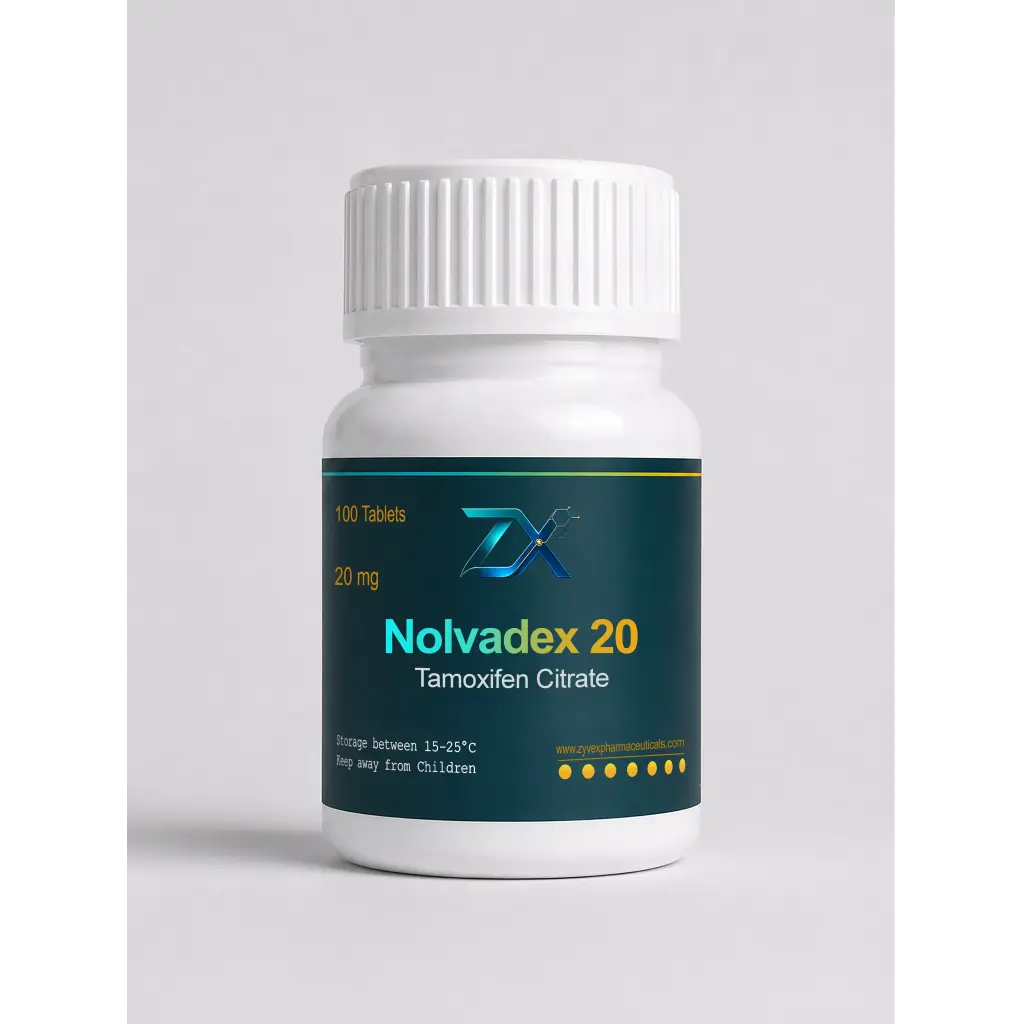
Product Class: Selective Estrogen Receptor Modulator (SERM)
Active Ingredient: Tamoxifen Citrate
Concentration: 20 mg/tab
Price For: 100 tablets
Brand: Nolvadex
Nolvadex 20 mg by Zyvex Pharmaceuticals contains Tamoxifen Citrate 20 mg per tablet and is supplied in packs of 100 tablets. Tamoxifen belongs to the pharmacological class known as Selective Estrogen Receptor Modulators (SERMs).
Tamoxifen has an established role in human medicine, particularly in the treatment and risk reduction of selected estrogen receptor-positive (ER-positive) breast cancers. Unlike aromatase inhibitors, Tamoxifen does not primarily work by preventing estrogen production. Instead, it binds to estrogen receptors and acts as an estrogen antagonist or partial agonist depending on the tissue.
This tissue-selective pharmacology explains both the therapeutic value and the adverse-effect profile of Tamoxifen. It can oppose estrogen signaling in breast tissue while retaining partial estrogen-like activity in tissues including bone, liver, and the endometrium.
Nolvadex is also frequently discussed in male endocrine and anabolic-steroid contexts, particularly in relation to gynecomastia and recovery of hypothalamic-pituitary-gonadal signaling after androgen suppression. These applications should be distinguished from established oncology indications and should not be interpreted as universal or self-directed "PCT" protocols.
The 20 mg designation describes the amount of Tamoxifen Citrate stated per tablet. Product strength alone does not determine an appropriate dose or treatment duration for an individual patient.
Tamoxifen is an established endocrine medication used primarily in breast-cancer management. Depending on the clinical setting and jurisdiction, applications include treatment of estrogen receptor-positive breast cancer and reduction of breast-cancer risk in selected high-risk individuals.
Because Tamoxifen interferes with estrogen-receptor signaling in breast tissue, it can reduce estrogen-driven proliferation of susceptible breast-cancer cells.
Treatment selection depends on factors such as tumor hormone-receptor status, menopausal status, disease stage, recurrence risk, previous therapy, contraindications, and individual adverse-effect risk.
Tamoxifen has also been used in selected male endocrine situations, including certain cases of gynecomastia. These applications require individualized assessment because breast enlargement or tenderness in men can have multiple causes and should not automatically be assumed to result from estrogen excess.
In anabolic-steroid and bodybuilding communities, Tamoxifen is commonly discussed for two broad purposes:
Tamoxifen does not directly remove anabolic steroids from the body and does not immediately reverse hypothalamic-pituitary-gonadal suppression. Recovery after exogenous androgen exposure depends on the substances used, duration of exposure, individual endocrine function, residual drug concentrations, and other factors.
Therefore, no universal post-cycle protocol can be inferred simply from the presence of 20 mg Tamoxifen tablets.
Tamoxifen binds to estrogen receptors and modifies estrogen-dependent gene transcription. Its effects vary according to tissue and cellular environment, which is why it is classified as a selective estrogen receptor modulator rather than a pure estrogen antagonist.
In breast tissue, Tamoxifen generally acts predominantly as an estrogen antagonist. By competing with estrogen for receptor binding, it can reduce estrogen-driven signaling in susceptible breast cells.
In other tissues, Tamoxifen can exhibit partial estrogen-agonist activity. This tissue selectivity contributes to effects involving:
Tamoxifen itself undergoes hepatic metabolism to pharmacologically active metabolites, including endoxifen. CYP2D6 contributes importantly to formation of endoxifen, making drug interactions with strong CYP2D6 inhibitors clinically relevant.
In males, antagonism of estrogenic negative feedback at the hypothalamic-pituitary level can increase gonadotropin signaling in some circumstances, potentially increasing LH and FSH and consequently endogenous testosterone production when the testes and endocrine axis remain capable of responding.
The potential benefits of Tamoxifen depend strongly on the indication for which it is prescribed.
In established clinical use, potential benefits include:
In selected male endocrine contexts, Tamoxifen may reduce estrogen-receptor stimulation of breast tissue and can influence hypothalamic-pituitary-gonadal signaling.
These potential benefits must be balanced against clinically significant adverse effects. Tamoxifen is associated with an increased risk of venous thromboembolic events and can produce hot flashes and other endocrine symptoms. Its partial estrogenic activity in the uterus is also associated with endometrial changes and an increased risk of endometrial malignancy in relevant populations.
Tamoxifen is used alongside other medications in legitimate oncology and endocrine care, while it is also discussed with several hormone-modifying drugs in non-medical anabolic-steroid contexts. The purpose of each combination should be clearly distinguished.
A SERM and an aromatase inhibitor should not be treated as interchangeable. Tamoxifen modifies estrogen-receptor signaling, whereas aromatase inhibitors reduce estrogen synthesis.
Routine combination of multiple endocrine drugs without laboratory and clinical justification can create unnecessary adverse effects and make hormone-related symptoms more difficult to interpret.
Nolvadex is not Testosterone Replacement Therapy. It does not provide exogenous testosterone and cannot directly replace deficient circulating testosterone.
However, Tamoxifen can affect endogenous reproductive endocrine signaling. By reducing estrogenic negative feedback at the hypothalamic-pituitary level, a SERM may increase LH and FSH in selected men with an intact and responsive hypothalamic-pituitary-gonadal axis.
This differs fundamentally from TRT. Testosterone replacement supplies an exogenous androgen and generally suppresses LH and FSH, whereas SERM therapy attempts to stimulate endogenous gonadotropin signaling.
This distinction can be particularly relevant when fertility is a clinical priority, since conventional exogenous testosterone can suppress intratesticular testosterone and sperm production.
Not every case of low testosterone responds appropriately to a SERM. Primary testicular failure, pituitary disorders, hyperprolactinemia, medication effects, obesity-related endocrine changes, and other causes require different evaluation and management.
Nolvadex contains Tamoxifen Citrate 20 mg per tablet. A pack of 100 tablets therefore contains a stated total of 2,000 mg of Tamoxifen Citrate according to the supplied product specification. This calculation describes package composition only.
In established medicine, Tamoxifen dosing and treatment duration depend on the indication, patient characteristics, concurrent treatment, and specialist treatment plan. A 20 mg tablet is a commonly recognized pharmaceutical strength, but tablet strength should not be interpreted as a universal dose for every indication.
For breast-cancer treatment and prevention, Tamoxifen may be used for prolonged periods when clinically indicated, with the regimen determined by oncology guidelines and the patient's individual risk-benefit profile.
For male endocrine applications, dosing cannot be inferred from oncology regimens because the therapeutic objectives and patient populations are different.
Likewise, the 20 mg tablet strength does not establish a bodybuilding "PCT" schedule. There is no single medically appropriate post-cycle regimen applicable to every anabolic steroid, ester, exposure duration, or individual endocrine state.
Tamoxifen differs fundamentally from anabolic-androgenic steroids discussed elsewhere in this product class catalog. It is not an androgen and does not carry the characteristic virilization profile of anabolic steroids.
Indeed, women represent a major clinical population for Tamoxifen because of its established role in hormone-sensitive breast-cancer therapy and risk reduction.
Relevant adverse effects can include:
Tamoxifen's partial estrogen-agonist activity in endometrial tissue is clinically important. Abnormal vaginal bleeding or other concerning gynecological symptoms during treatment require medical evaluation.
Pregnancy requires special consideration. Tamoxifen can pose fetal risk and should be managed according to specialist guidance regarding pregnancy avoidance and reproductive planning.
Nolvadex 20 mg by Zyvex Pharmaceuticals contains Tamoxifen Citrate 20 mg per tablet and is supplied in packs of 100 tablets. Tamoxifen is a selective estrogen receptor modulator with an established medical role in hormone-sensitive breast-cancer treatment and risk reduction.
Unlike aromatase inhibitors, Tamoxifen does not primarily reduce estrogen synthesis. Instead, it selectively modifies estrogen-receptor signaling, producing antiestrogenic effects in breast tissue while retaining partial estrogenic activity in certain other tissues. It is also encountered in selected male endocrine and post-anabolic-steroid contexts, but it is not TRT and the 20 mg tablet strength does not establish a universal PCT regimen. Clinically important risks—including venous thromboembolism and endometrial effects—must be considered when evaluating Tamoxifen therapy.
Tamoxifen is the active pharmaceutical agent associated with the Nolvadex brand. The supplied Zyvex Pharmaceuticals product lists Tamoxifen Citrate as its active substance.
Not in the same way as an aromatase inhibitor. Tamoxifen primarily changes how estrogen signals through its receptor in different tissues rather than directly suppressing estrogen production.
Tamoxifen has been used in selected cases of gynecomastia because it can antagonize estrogen-receptor signaling in breast tissue. Persistent or unexplained male breast enlargement should be clinically evaluated because multiple endocrine and non-endocrine causes are possible.
Tamoxifen is commonly discussed in post-anabolic-steroid recovery contexts because SERMs can influence LH and FSH signaling. There is no universal medically validated PCT schedule applicable to every steroid exposure or individual.
Both are SERMs, but Tamoxifen and Clomiphene have different clinical indications, receptor pharmacology, metabolites, and adverse-effect profiles. They should not automatically be considered interchangeable.
Nolvadex modifies estrogen-receptor signaling, whereas Arimidex inhibits aromatase and decreases estrogen synthesis. They therefore address estrogen physiology through different mechanisms.
Please log in to write Nolvadex 20 mg review.

Product Class: Selective Estrogen Receptor Modulator (SERM)
Active Ingredient: Tamoxifen Citrate
Concentration: 20 mg per tablet
Price For: 100 tablets
Brand: Nolvadex

Selective Estrogen Receptor Modulator
Active Ingredient: Tamoxifen Citrate
Concentration: 20 mg / pill
Price For: 50 pills
Brand: British Dragon Pharmaceuticals

Selective Estrogen Receptor Modulator
Active Ingredient: Tamoxifen Citrate
Concentration: 20 mg / pill
Price For: 50 pills
Brand: Axiolabs

Selective Estrogen Receptor Modulator
Active Ingredient: Tamoxifen Citrate
Concentration: 20 mg / pill
Price For: 30 pills
Brand: Kalpa Pharmaceuticals