


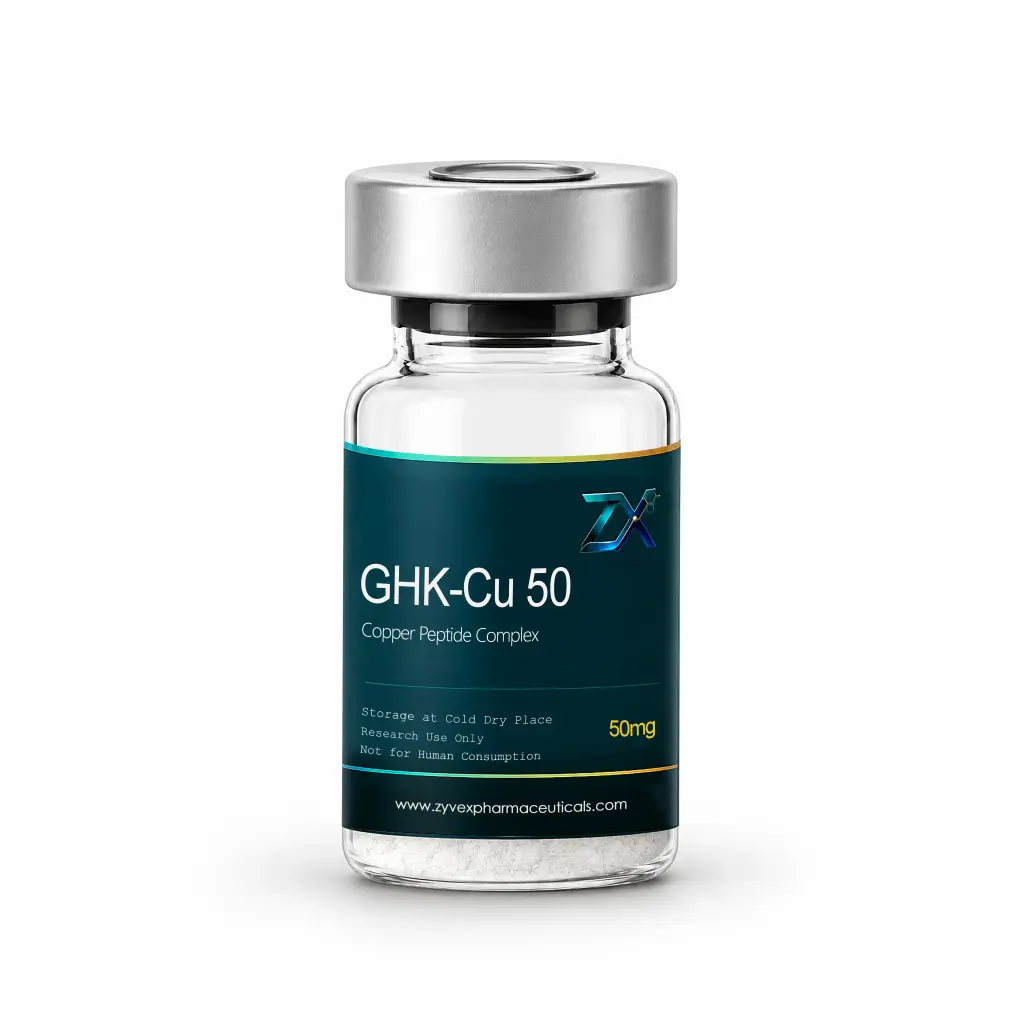
Product Class: Copper-Binding Peptide / Investigational Regenerative Peptide
Active Ingredient: GHK-Cu (Copper Tripeptide-1)
Concentration: 50 mg/vial
Price For: 1 vial
Brand: Copper Peptide
GHK-CU 50 by Zyvex Pharmaceuticals contains GHK-Cu 50 mg per vial. GHK-Cu is the copper complex of the naturally occurring tripeptide glycyl-L-histidyl-L-lysine (GHK) and is commonly referred to as Copper Tripeptide-1 or a copper peptide.
GHK is capable of binding copper ions, forming the GHK-Cu complex. This peptide-metal complex has attracted scientific interest because copper participates in numerous biological processes, including extracellular-matrix formation, antioxidant defense, connective-tissue biology, wound repair, and enzyme function.
GHK-Cu differs fundamentally from anabolic-androgenic steroids, SARMs, growth hormone, IGF-1 analogues, and growth-hormone secretagogues. It is not an androgen, anabolic steroid, SARM, or testosterone derivative and does not produce its proposed biological effects through androgen-receptor activation.
Topical copper peptides are widely encountered in cosmetic and skin-care applications. By contrast, systemic or injectable GHK-Cu should be considered investigational: research interest does not establish an approved systemic therapeutic indication, standardized injectable treatment protocol, or proven performance-enhancement regimen.
The 50 mg designation describes the stated amount of GHK-Cu contained in the vial. It should not be interpreted as a recommended injection dose or treatment course.
GHK-Cu has been studied primarily for biological activities related to skin, connective tissue, wound repair, inflammation, and tissue remodeling. Copper Tripeptide-1 is also encountered as an ingredient in topical cosmetic preparations intended to support the appearance and condition of skin.
Research involving GHK-Cu has explored potential effects on processes such as collagen and extracellular-matrix biology, fibroblast activity, wound repair, antioxidant defenses, inflammatory signaling, and tissue remodeling.
These areas of research should not be confused with regulatory approval of injectable GHK-Cu for systemic regenerative medicine. Evidence supporting a biological mechanism or topical cosmetic application does not establish the safety and effectiveness of systemic peptide administration.
In peptide and performance-oriented communities, GHK-Cu is sometimes discussed in relation to:
GHK-Cu should not be characterized as a direct muscle-building anabolic agent. Evidence supporting substantial skeletal-muscle hypertrophy, strength enhancement, or athletic-performance improvement from systemic GHK-Cu in humans is insufficient.
GHK is a three-amino-acid peptide composed of glycine, histidine, and lysine. Its histidine-containing structure enables it to bind copper, producing the biologically active complex commonly designated GHK-Cu.
Copper is an essential trace element and a cofactor for multiple enzymes involved in tissue structure, redox biology, and cellular metabolism. Complexation with GHK may influence the transport and biological availability of copper at tissue and cellular levels.
Experimental research has associated GHK-Cu with several interconnected biological processes, including:
GHK-Cu has also attracted interest for potential effects on gene-expression patterns involved in tissue remodeling and cellular repair. However, mechanistic findings from cell culture, animal models, or laboratory experiments cannot automatically be translated into proven systemic therapeutic effects in humans.
Unlike testosterone or anabolic steroids, GHK-Cu does not depend on androgen-receptor activation. Unlike growth-hormone secretagogues such as Ipamorelin, it is not principally intended to stimulate the ghrelin receptor and increase growth-hormone secretion.
The most plausible potential benefits of GHK-Cu relate to its experimentally observed roles in tissue and extracellular-matrix biology rather than direct anabolic steroid-like effects.
Areas of scientific interest include:
Topical copper-peptide applications have substantially different exposure characteristics from systemic administration. Evidence for cosmetic skin effects therefore should not be used to claim equivalent benefits from an injectable preparation.
Claims involving accelerated tendon healing, major muscle regeneration, systemic anti-aging, organ regeneration, or substantial athletic-performance enhancement remain insufficiently established for routine clinical use.
GHK-Cu is frequently discussed alongside other regenerative and growth-related peptides. These combinations are largely experimental and should not be interpreted as clinically validated treatment protocols.
There is no established evidence that combining these agents creates a predictable or clinically validated synergistic regenerative effect. Using multiple investigational peptides simultaneously also makes adverse reactions and treatment outcomes more difficult to attribute to a specific compound.
GHK-Cu already contains coordinated copper. Additional copper supplementation should not automatically be assumed beneficial, because excessive systemic copper exposure can be harmful.
GHK-Cu has no established role in Hormone Replacement Therapy or Testosterone Replacement Therapy.
It does not provide testosterone, activate the androgen receptor as its primary mechanism, or replace physiological androgen signaling. It also does not function as a SERM, aromatase inhibitor, gonadotropin, or conventional fertility medication.
Unlike exogenous anabolic-androgenic steroids, GHK-Cu is not expected to produce classical androgen-mediated hypothalamic-pituitary-gonadal suppression through the same mechanism.
However, the absence of androgenic activity should not be interpreted as proof that systemic high-dose or injectable exposure has been fully characterized for endocrine safety.
Patients with clinically confirmed testosterone deficiency require assessment and treatment based on established endocrine principles rather than substitution with a regenerative research peptide.
GHK-CU 50 contains 50 mg of GHK-Cu per vial. The stated 50 mg quantity describes vial content and should not be interpreted as a recommended single dose, daily dose, or complete treatment course.
Topical Copper Tripeptide-1 used in cosmetic products and systemic GHK-Cu administration are not interchangeable forms of exposure. Concentrations used in skin-care formulations cannot simply be converted into injectable dosing.
For investigational systemic GHK-Cu, there is no universally accepted regulator-approved human dosing regimen for tissue regeneration, athletic recovery, bodybuilding, anti-aging, or systemic wound healing.
Consequently, no validated injection frequency, dose-escalation schedule, treatment cycle, or peptide-stack regimen can safely be inferred from a 50 mg vial.
Product quality is particularly important for substances intended for parenteral research because peptide identity, purity, sterility, endotoxin contamination, particulate contamination, concentration accuracy, and storage stability can all influence safety. A labeled peptide concentration alone does not establish pharmaceutical-grade sterility or suitability for human injection.
GHK-Cu is not an androgenic anabolic steroid and therefore does not carry the characteristic virilization profile associated with compounds such as Testosterone, Trenbolone, Stanozolol, or Oxandrolone.
Effects such as androgen-driven voice deepening, clitoral enlargement, male-pattern hair growth, and androgenic scalp hair loss are not expected from GHK-Cu through an androgen-receptor mechanism.
However, this does not establish systemic GHK-Cu as proven safe for women. Human safety information for investigational systemic administration remains much less developed than the safety information available for established medicines.
Pregnancy and breastfeeding require particular caution because adequate reproductive and developmental safety data for systemic investigational GHK-Cu are not established. Absence of androgenicity is not equivalent to demonstrated reproductive safety.
GHK-Cu should not be considered equivalent to an oral nutritional copper supplement. In GHK-Cu, copper is coordinated to a specific tripeptide, producing different biochemical characteristics from dietary copper salts. Conversely, the existence of a copper-binding peptide does not mean that additional systemic copper exposure is automatically beneficial.
GHK-CU 50 by Zyvex Pharmaceuticals contains GHK-Cu 50 mg per vial. Also known as Copper Tripeptide-1, GHK-Cu is a copper-binding tripeptide associated with research involving extracellular-matrix remodeling, fibroblast activity, collagen biology, wound repair, antioxidant processes, and skin biology.
GHK-Cu is fundamentally different from anabolic steroids, SARMs, growth hormone, and testosterone-replacement medications. Although topical copper peptides have established cosmetic relevance and GHK-Cu has generated considerable regenerative research interest, systemic injectable applications remain investigational and should not be presented as proven treatments for muscle growth, injury repair, anti-aging, or hormone replacement. The 50 mg designation describes vial content rather than a validated human dose or treatment protocol.
GHK-Cu is a complex formed between copper and the naturally occurring tripeptide glycyl-L-histidyl-L-lysine. It is commonly referred to as a copper peptide or Copper Tripeptide-1.
The supplied product specification indicates 50 mg of GHK-Cu per vial. This represents vial content rather than a recommended administration dose.
Research has examined GHK-Cu in relation to wound repair, extracellular-matrix remodeling, collagen biology, fibroblast activity, inflammatory signaling, antioxidant processes, skin biology, and related regenerative pathways.
Copper peptides are encountered in cosmetic scalp and hair products, and GHK-Cu has been investigated in skin and follicular biology. Evidence should be interpreted according to the specific formulation and route rather than assuming injectable GHK-Cu produces the same effect.
GHK-Cu is discussed in some bodybuilding communities primarily for recovery or tissue-related objectives rather than as a direct anabolic steroid. Robust evidence demonstrating clinically meaningful muscle hypertrophy or athletic-performance enhancement in humans is lacking.
GHK-Cu is not established as a testosterone-stimulating medication and does not function as TRT. It should not be expected to correct clinically diagnosed androgen deficiency.
Please log in to write GHK-Cu 50 review.
Product Class: Copper-Binding Regenerative Peptide
Active Ingredient: GHK-Cu (Copper Tripeptide-1)
Concentration: 50 mg/vial
Price For: 1 vial
Brand: Copper Peptide
Growth Hormone Analog
Active Ingredient: Somatropin (r-hGH)
Concentration: 20 IU / vial
Price For: 1 kit [10 x Vials]
Brand: Kalpa Pharmaceuticals
Human Peptide Hormone
Active Ingredient: Tirzepatide
Concentration: 5 mg / vial
Price For: 2 mL Vial
Brand: Kalpa Pharmaceuticals
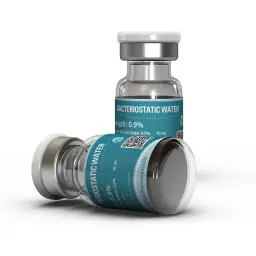
Water for Injection
Active Ingredient: Sterile Water
Concentration: 0.9% / vial
Price For: 2 mL Vial
Brand: Kalpa Pharmaceuticals