


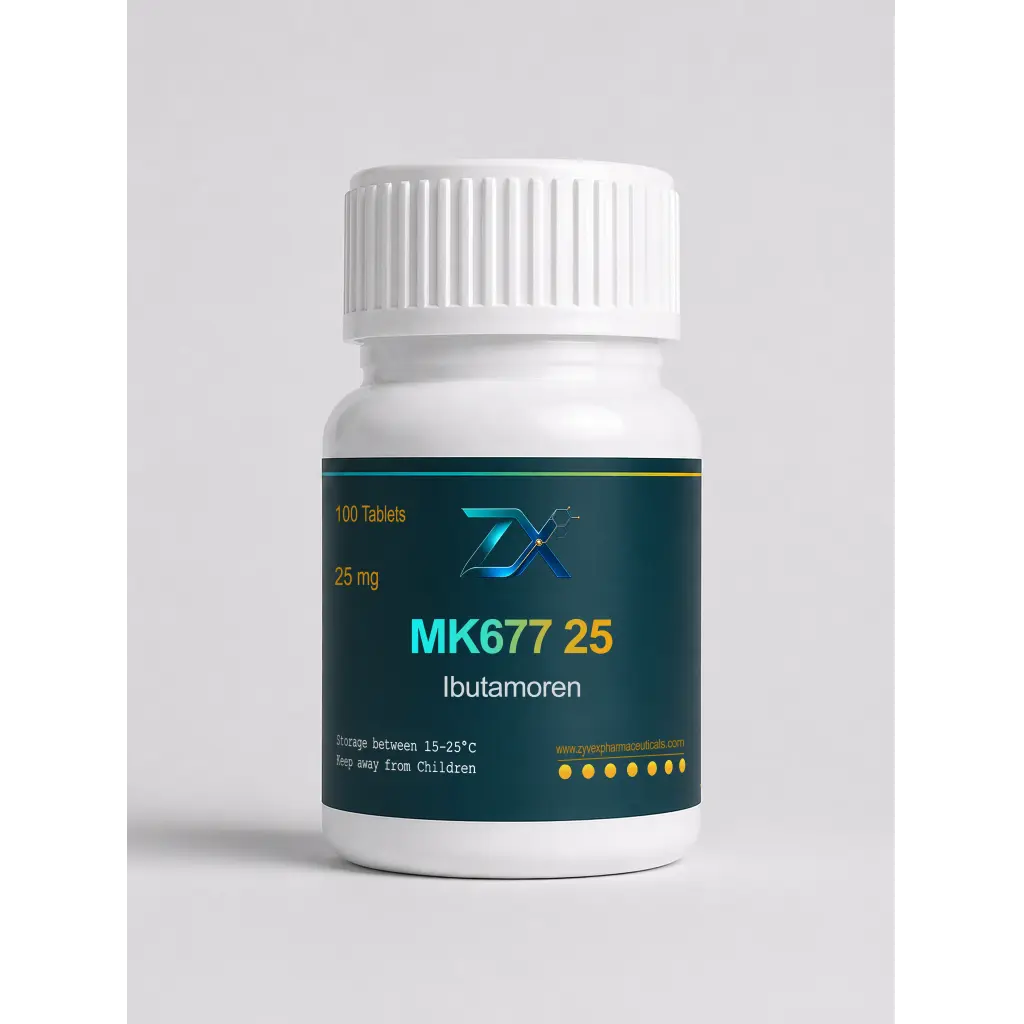
Product Class: Investigational Growth Hormone Secretagogue / Ghrelin Receptor Agonist
Active Ingredient: Ibutamoren (MK-677)
Concentration: 25 mg/tab
Price For: 100 tablets
Brand: Ibutamoren
Ibutamoren (MK-677) 25 mg by Zyvex Pharmaceuticals contains Ibutamoren 25 mg per tablet and is supplied in packs of 100 tablets. Ibutamoren, commonly identified by the research designation MK-677, is an orally active growth hormone secretagogue and agonist of the ghrelin/growth hormone secretagogue receptor, GHS-R1a.
MK-677 is frequently grouped with SARMs in online bodybuilding terminology, but this classification is pharmacologically incorrect. Ibutamoren is not a selective androgen receptor modulator (SARM), anabolic steroid, peptide, or testosterone derivative. It is a non-peptide small molecule that stimulates endogenous growth hormone (GH) secretion through ghrelin-receptor signaling.
Activation of this pathway can increase pulsatile GH secretion and circulating insulin-like growth factor 1 (IGF-1). These endocrine effects have led to research interest in conditions involving muscle loss, altered body composition, bone metabolism, growth-hormone physiology, and aging.
Ibutamoren remains an investigational compound rather than an established routine human medicine. It should therefore not be presented as approved therapy for bodybuilding, anti-aging, muscle growth, growth-hormone deficiency, or recovery.
The 25 mg designation describes the stated quantity of Ibutamoren in each tablet. It should not automatically be interpreted as a recommended daily dose or performance-enhancement regimen.
Ibutamoren has been investigated for its ability to stimulate endogenous GH secretion and increase circulating IGF-1. Research interest has included populations or conditions involving altered body composition, age-related physiological changes, muscle loss, bone metabolism, and other settings where modulation of the GH/IGF-1 axis could theoretically be relevant.
Clinical research demonstrating biological activity does not establish routine therapeutic approval. Ibutamoren should therefore be distinguished from approved recombinant human growth hormone preparations used for specific medically diagnosed disorders.
Its ability to increase GH or IGF-1 also does not establish that treatment will improve every clinical outcome associated with these biomarkers. Changes in hormone concentrations, lean body mass, strength, functional performance, and long-term health outcomes are separate endpoints.
In bodybuilding and performance communities, MK-677 is commonly discussed in relation to:
These uses remain distinct from established medical therapy. Ibutamoren should not be described as producing anabolic-steroid-like muscle growth simply because it can influence the GH/IGF-1 axis.
Importantly, increased appetite and fluid retention can also contribute to changes in body weight. An increase on the scale therefore cannot automatically be interpreted as new skeletal-muscle tissue.
Ibutamoren acts primarily as an agonist at the growth hormone secretagogue receptor type 1a (GHS-R1a), commonly known as the ghrelin receptor.
Ghrelin signaling participates in growth-hormone secretion, appetite regulation, energy balance, and several neuroendocrine processes. By activating GHS-R1a, Ibutamoren can stimulate endogenous pulsatile GH secretion.
Increased GH signaling can subsequently stimulate hepatic and peripheral production of IGF-1, an important mediator of many growth-hormone effects.
Potential downstream effects of GH/IGF-1 modulation involve:
Unlike exogenous recombinant growth hormone, MK-677 does not directly supply GH. Instead, it stimulates endogenous secretion through receptor-mediated neuroendocrine signaling.
Likewise, it does not activate the androgen receptor like testosterone, anabolic steroids, or SARMs. Its endocrine effects therefore belong to a fundamentally different pharmacological pathway.
Potential effects investigated or discussed in relation to Ibutamoren largely derive from sustained stimulation of the GH/IGF-1 axis.
Areas of scientific interest include:
One feature distinguishing Ibutamoren from injectable GH is its oral activity and ability to stimulate the body's own growth-hormone secretion rather than supplying recombinant hormone directly.
Potential benefits must be balanced against its metabolic effects. GH/IGF-1 signaling interacts significantly with insulin and glucose physiology, and Ibutamoren has been associated in research settings with changes in insulin sensitivity and glucose regulation.
Other reported or biologically plausible effects include increased appetite, fluid retention, edema, musculoskeletal symptoms, and altered glucose homeostasis. These effects are particularly relevant in individuals with diabetes, prediabetes, obesity, or other metabolic risk factors.
Ibutamoren is frequently discussed alongside peptides, anabolic compounds, and other GH-axis agents. These combinations are generally performance-oriented or experimental rather than validated medical protocols.
Using multiple agents that increase GH or IGF-1 signaling can increase concerns involving edema, glucose regulation, insulin resistance, musculoskeletal symptoms, and other GH-related adverse effects.
No standardized clinical "stack" involving MK-677 has been established for bodybuilding or athletic recovery.
Ibutamoren is not Testosterone Replacement Therapy (TRT). It does not supply testosterone and does not function primarily through androgen receptors.
TRT is intended to replace deficient testosterone in appropriately diagnosed patients. Ibutamoren instead stimulates the ghrelin receptor and influences the GH/IGF-1 endocrine axis.
For the same reason, MK-677 should not be regarded as an alternative treatment for clinically confirmed testosterone deficiency.
Unlike exogenous anabolic-androgenic steroids, Ibutamoren is not expected to cause classical hypothalamic-pituitary-gonadal suppression through androgen-receptor negative feedback. It therefore has a fundamentally different reproductive endocrine profile from Testosterone, Trenbolone, Nandrolone, Stanozolol, or SARMs.
This distinction does not mean that Ibutamoren is endocrine-neutral. It deliberately modifies GH and IGF-1 signaling and can influence glucose, insulin, appetite, fluid balance, and other metabolic pathways.
Ibutamoren by Zyvex Pharmaceuticals contains 25 mg per tablet. A pack of 100 tablets therefore contains a stated total of 2,500 mg of Ibutamoren. This calculation describes package composition only.
The 25 mg tablet strength is not automatically a recommended dose. Ibutamoren remains investigational, and there is no universally accepted regulator-approved regimen for bodybuilding, anti-aging, athletic recovery, muscle growth, or routine hormone optimization.
Clinical research has evaluated specific experimental exposures under controlled protocols, but research-study dosing should not automatically be converted into self-directed use.
No validated bodybuilding cycle, dose-escalation schedule, combination protocol, or long-term performance regimen can safely be inferred from the tablet strength.
Because Ibutamoren can influence glucose and insulin physiology, metabolic status is an important consideration in research and clinical evaluation. Increased GH signaling can oppose some actions of insulin, making glucose-related adverse effects particularly relevant in susceptible individuals.
Ibutamoren is not an androgenic steroid and therefore does not carry the characteristic virilization profile of testosterone-derived or DHT-derived anabolic steroids.
Classical androgenic effects such as voice deepening, clitoral enlargement, androgen-driven facial hair growth, and male-pattern androgenic changes are not expected through Ibutamoren's primary mechanism.
However, absence of androgenic activity does not establish systemic safety for women. Potential effects involving glucose metabolism, appetite, edema, fluid balance, and the GH/IGF-1 axis remain relevant regardless of sex.
Pregnancy and breastfeeding require particular caution because adequate reproductive and developmental safety data for investigational Ibutamoren exposure are not established.
The 25 mg tablet strength should not be interpreted as a validated female performance or anti-aging dose.
Ibutamoren (MK-677) 25 mg by Zyvex Pharmaceuticals contains Ibutamoren 25 mg per tablet and is supplied in packs of 100 tablets. MK-677 is an orally active, non-peptide growth-hormone secretagogue that activates the ghrelin/GHS-R1a receptor and can increase endogenous GH and IGF-1 signaling.
Ibutamoren is not a SARM, anabolic steroid, peptide, or form of testosterone replacement. Research has examined its effects on GH secretion, IGF-1, lean body mass, bone metabolism, and other physiological endpoints, but it remains investigational rather than an established bodybuilding, anti-aging, or hormone-replacement therapy. Increased appetite, fluid retention, and adverse changes in glucose and insulin physiology are important considerations. The 25 mg designation describes tablet strength rather than a universally validated human dose or performance protocol.
Ibutamoren, also known as MK-677, is an orally active growth-hormone secretagogue that activates the ghrelin/GHS-R1a receptor and can increase endogenous GH and IGF-1.
Yes. Controlled research has demonstrated that Ibutamoren can stimulate endogenous GH secretion and increase circulating IGF-1.
Yes. Increased growth-hormone signaling can increase circulating IGF-1, which is one of the principal biological effects investigated with MK-677.
Yes. Fluid retention and edema can occur with increased GH-axis activity and are relevant potential adverse effects of Ibutamoren.
No. Ibutamoren does not replace testosterone and is not a treatment equivalent to Testosterone Enanthate, Cypionate, or other established TRT formulations.
Please log in to write Ibutamoren MK-677 review.

Growth Hormone Secretagogue
Active Ingredient: Ibutameron
Concentration: 25 mg / pill
Price For: 100 pills
Brand: Dragon Pharma
Growth Hormone Analog
Active Ingredient: Somatropin (r-hGH)
Concentration: 20 IU / vial
Price For: 1 kit [10 x Vials]
Brand: Kalpa Pharmaceuticals

Human Peptide Hormone
Active Ingredient: Tirzepatide
Concentration: 5 mg / vial
Price For: 2 mL Vial
Brand: Kalpa Pharmaceuticals

Water for Injection
Active Ingredient: Sterile Water
Concentration: 0.9% / vial
Price For: 2 mL Vial
Brand: Kalpa Pharmaceuticals