


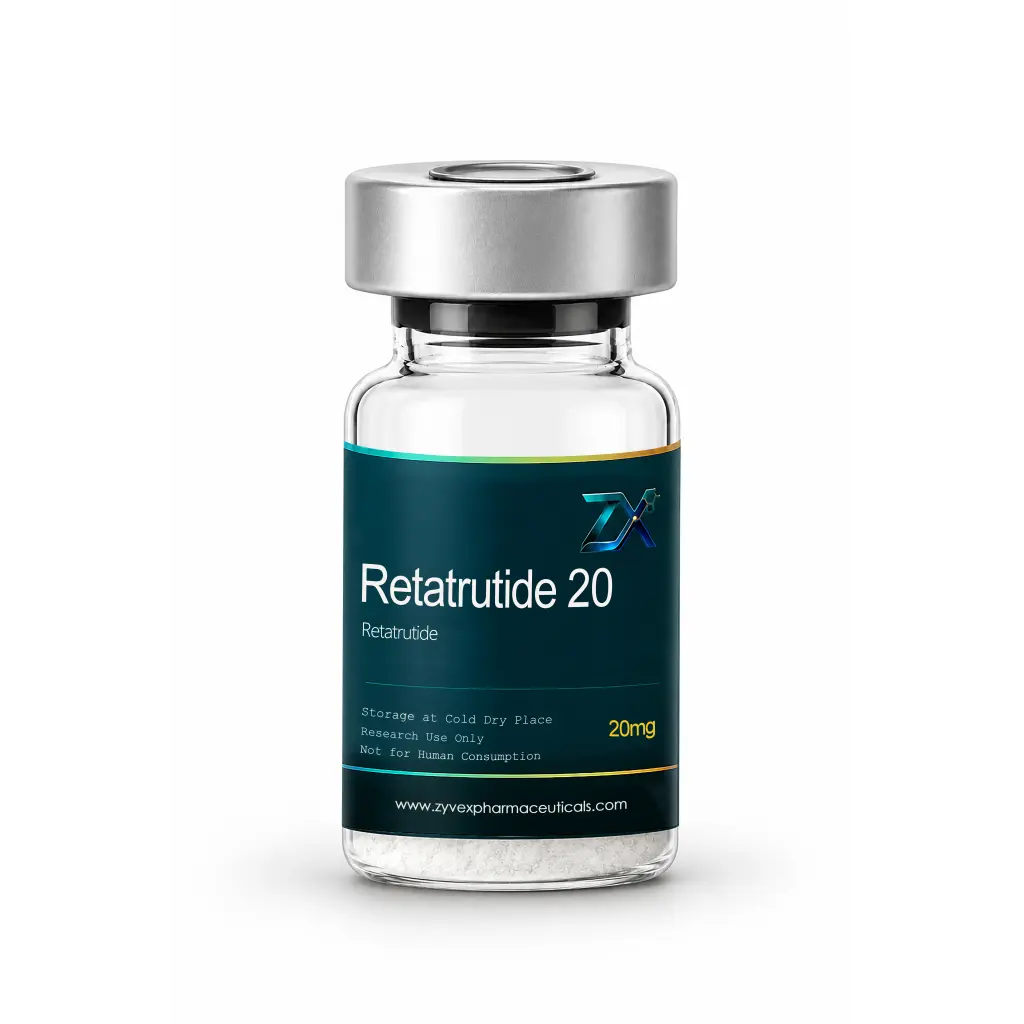
Product Class: Investigational GIP/GLP-1/Glucagon Triple Receptor Agonist
Active Ingredient: Retatrutide
Concentration: 20 mg/vial
Price For: 1 vial
Brand: Retatrutide
Retatrutide 20 by Zyvex Pharmaceuticals is labeled as containing Retatrutide 20 mg per vial. Retatrutide, also known by the development code LY3437943, is an investigational peptide-based metabolic drug designed to activate three hormone-receptor systems: glucose-dependent insulinotropic polypeptide (GIP), glucagon-like peptide-1 (GLP-1), and glucagon receptors.
This pharmacological profile distinguishes Retatrutide from single GLP-1 receptor agonists such as Semaglutide and from dual GIP/GLP-1 receptor agonists such as Tirzepatide. Because it simultaneously targets GIP, GLP-1, and glucagon receptors, Retatrutide is commonly described as a triple agonist.
As of September 2026, Retatrutide remains an investigational medicine and has not been approved by the FDA or another regulatory agency for public use. Eli Lilly, the developer of the investigational molecule, states that Retatrutide is currently available only through its clinical-trial program and warns against products claiming to contain Retatrutide outside that setting.
Retatrutide has nevertheless produced substantial weight-loss results in controlled clinical trials. In the published Phase 2 obesity study, participants receiving the highest studied dose experienced a mean body-weight reduction of approximately 24.2% at 48 weeks. More recently, Lilly reported positive Phase 3 TRIUMPH-1 results, with participants assigned to 12 mg achieving an average 28.3% weight reduction at 80 weeks.
The 20 mg vial designation describes the stated total amount of compound in the vial. It should not be interpreted as an approved single dose, weekly dose, or treatment regimen.
Retatrutide is being developed primarily as a metabolic therapy for obesity and related cardiometabolic conditions. Its clinical-development program has included or continues to include research in:
Lilly reported in July 2026 that additional Phase 3 trials were successful in adults with obesity or overweight and type 2 diabetes and in adults with severe obesity and established cardiovascular disease. The company has stated that it plans an FDA Biologics License Application submission in the first quarter of 2027.
These results represent late-stage clinical development rather than current regulatory approval. Retatrutide should therefore not be described as an approved obesity, diabetes, cardiovascular, or weight-management medication.
Retatrutide has attracted considerable attention in bodybuilding and physique communities because of its effects on appetite, energy intake, body weight, and fat mass.
Non-medical discussions commonly focus on:
These applications should not be confused with an established athletic-performance indication. Retatrutide is not an anabolic steroid and does not directly stimulate skeletal-muscle androgen receptors.
Retatrutide is a single molecular agonist engineered to activate GIP, GLP-1, and glucagon receptors. This combination is intended to influence multiple complementary pathways involved in appetite, glucose metabolism, insulin secretion, nutrient signaling, and energy balance.
GLP-1 receptor activation can reduce appetite and energy intake, improve glucose-dependent insulin secretion, suppress inappropriate glucagon release under certain metabolic conditions, and slow gastrointestinal processes that contribute to satiety.
GIP is another nutrient-responsive incretin hormone. GIP-receptor agonism can contribute to glucose-dependent insulin signaling and may interact with GLP-1 pathways to influence appetite and metabolic regulation.
Glucagon-receptor agonism distinguishes Retatrutide from therapies that target only GLP-1 or GIP/GLP-1 receptors. Glucagon signaling can influence hepatic energy metabolism and may contribute to increased energy expenditure, although it also has important effects on glucose physiology.
The therapeutic concept behind Retatrutide is therefore not simply stronger appetite suppression. It combines several metabolic signals in one molecule to alter both energy intake and energy balance.
Retatrutide has an approximate half-life of six days in published research, supporting once-weekly administration in clinical trials.
The strongest clinical evidence for Retatrutide currently relates to substantial reductions in body weight in adults with obesity.
Potential areas of benefit under investigation include:
In the Phase 2 obesity trial, mean body-weight changes at 48 weeks were approximately −8.7%, −17.1%, −22.8%, and −24.2% across increasing Retatrutide dose groups, compared with −2.1% with placebo.
In the Phase 3 TRIUMPH-1 trial reported in May 2026, Lilly stated that the 12 mg group achieved an average weight reduction of 28.3% at 80 weeks, while participants in an extended evaluation with baseline BMI of at least 35 achieved an average reduction of up to 30.3% at 104 weeks.
These findings are clinically significant but should not be interpreted as guaranteeing the same results in every individual or with any independently manufactured product claiming to contain Retatrutide.
Retatrutide should generally be viewed as a pharmacologically complex metabolic agent rather than a compound requiring a conventional "stack." It already targets three major hormonal receptor systems within a single molecule.
Compounds commonly compared with or discussed alongside Retatrutide include:
Combining Retatrutide with other GLP-1, GIP/GLP-1, glucagon-modifying, or potent appetite-suppressing medications has not been established as a standard clinical strategy and could increase gastrointestinal, metabolic, or other adverse effects.
Concurrent use with insulin or glucose-lowering medications would also require particular medical consideration because substantial metabolic changes may alter hypoglycemia risk or medication requirements.
Retatrutide has no established role in Hormone Replacement Therapy or Testosterone Replacement Therapy.
Although it is a hormone-receptor agonist, the receptors involved are metabolic receptors—GIP, GLP-1, and glucagon—not androgen receptors.
Retatrutide does not:
Weight loss can indirectly alter testosterone concentrations in some people with obesity, but this is not equivalent to using Retatrutide as testosterone therapy.
Retatrutide 20 contains a stated 20 mg of Retatrutide per vial. This describes total vial content only.
Retatrutide does not currently have an approved public-use dosing regimen because it remains investigational. In Lilly-sponsored clinical trials it is administered as a once-weekly subcutaneous injection using defined research protocols.
Published Phase 2 and Phase 3 studies have evaluated multiple experimental dose levels with controlled titration procedures, but these trial regimens should not be converted into instructions for independently sourced products.
Therefore, a 20 mg vial should not be interpreted as:
This distinction is particularly important because Lilly states that Retatrutide has not been approved by any regulatory agency and warns that products sold outside its clinical-trial program may contain incorrect quantities, impurities, contaminants, or even the wrong active ingredient.
Retatrutide is not androgenic and therefore does not have the characteristic virilization profile associated with anabolic-androgenic steroids.
Androgen-mediated effects such as voice deepening, clitoral enlargement, male-pattern facial hair growth, or other classical virilizing changes are not expected from its GIP/GLP-1/glucagon mechanism.
However, women remain susceptible to the same metabolic and gastrointestinal adverse effects as other users. Potential concerns include:
Pregnancy requires particular caution. Intentional pharmacological weight loss is generally not a goal during pregnancy, and adequate pregnancy safety information for investigational Retatrutide is not established.
The 20 mg vial strength should not be interpreted as a validated female dose.
Retatrutide is not an anabolic steroid and does not directly activate androgen receptors. Its body-composition effects arise primarily from changes in appetite, energy balance, and metabolic hormone signaling rather than direct androgen-mediated muscle anabolism.
Retatrutide 20 by Zyvex Pharmaceuticals is labeled as containing Retatrutide 20 mg per vial. Retatrutide is an investigational GIP, GLP-1, and glucagon triple receptor agonist being developed for obesity and associated metabolic disorders.
Clinical research has produced substantial weight-loss results, including mean reductions exceeding 20% in several late-stage study groups. However, as of September 2026, Retatrutide remains unapproved and Lilly has stated that the compound is intended to be available only within its clinical-trial program while development and regulatory evaluation continue. The 20 mg vial designation therefore describes stated product content rather than an approved dose or self-directed weight-loss protocol.
Retatrutide is an investigational peptide-based metabolic drug that activates GIP, GLP-1, and glucagon receptors within a single molecule.
No. Tirzepatide activates GIP and GLP-1 receptors, whereas Retatrutide additionally activates the glucagon receptor.
No. Semaglutide is primarily a GLP-1 receptor agonist, while Retatrutide is a GIP/GLP-1/glucagon triple agonist.
Yes. Controlled Phase 2 and Phase 3 trials have demonstrated substantial mean weight reductions in adults with obesity. Phase 2 participants in the highest-dose group lost an average 24.2% of body weight at 48 weeks, while Lilly reported an average 28.3% reduction at 80 weeks in the 12 mg arm of TRIUMPH-1.
It simultaneously activates GIP, GLP-1, and glucagon receptors, influencing appetite, insulin and glucose physiology, nutrient signaling, and overall energy balance.
Reduced food intake is an important component of its metabolic effect, particularly through incretin and central satiety pathways.
It has attracted bodybuilding interest for fat-loss and body-composition purposes, but bodybuilding is not an approved clinical indication and Retatrutide remains investigational.
Please log in to write Retatrutide 20 mg review.
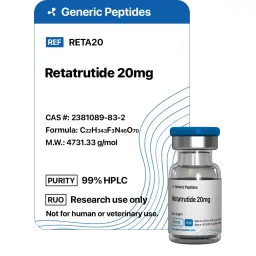
Human Peptide Hormone
Active Ingredient: Retatrutide
Concentration: 20 mg / vial
Price For: 1 Vial
Brand: Generic Peptides
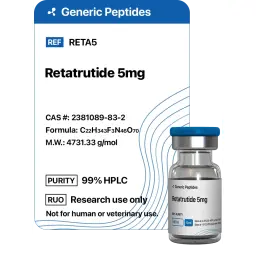
Human Peptide Hormone
Active Ingredient: Retatrutide
Concentration: 5 mg / vial
Price For: 1 Vial
Brand: Generic Peptides
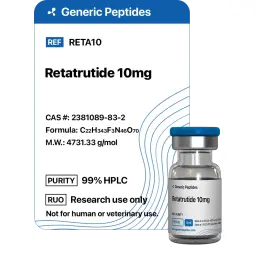
Human Peptide Hormone
Active Ingredient: Retatrutide
Concentration: 10 mg / vial
Price For: 1 Vial
Brand: Generic Peptides