


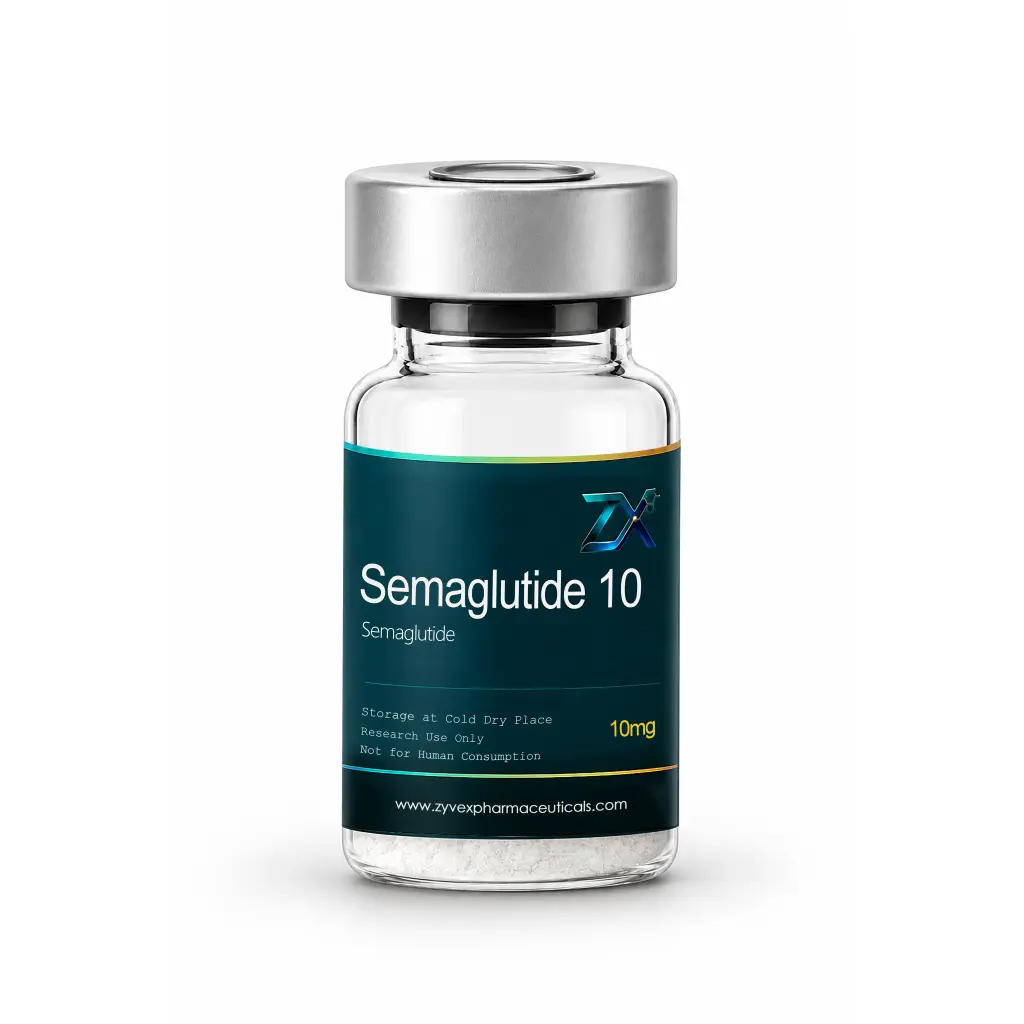
Product Class: GLP-1 Receptor Agonist / Incretin-Based Metabolic Agent
Active Ingredient: Semaglutide
Concentration: 10 mg/vial
Price For: 1 vial
Brand: Semaglutide
Semaglutide 10 by Zyvex Pharmaceuticals is labeled as containing Semaglutide 10 mg per vial. Semaglutide belongs to the glucagon-like peptide-1 (GLP-1) receptor agonist class, a group of incretin-based medicines that influence appetite, glucose-dependent insulin secretion, gastric emptying, and metabolic regulation.
Semaglutide itself is an established pharmaceutical molecule used in FDA-approved products including formulations marketed under the Ozempic, Wegovy, and Rybelsus names. Current U.S. labeling includes injectable and oral formulations with indications spanning type 2 diabetes, chronic weight management, cardiovascular risk reduction in selected patients, and specific uses involving metabolic dysfunction-associated steatohepatitis (MASH).
However, regulatory approval of the semaglutide molecule in specific branded formulations does not mean that every product labeled "Semaglutide" is FDA-approved or therapeutically interchangeable with Ozempic or Wegovy. Based solely on the supplied product information, this Zyvex Pharmaceuticals 10 mg vial should not be represented as an FDA-approved Ozempic or Wegovy equivalent.
FDA specifically warns that unapproved semaglutide products do not undergo the same premarket review for safety, effectiveness, quality, concentration accuracy, and manufacturing standards as approved medicines. FDA has also highlighted dosing errors and adverse events associated with compounded injectable semaglutide products supplied in multidose vials.
The 10 mg designation describes the stated total amount of Semaglutide contained in the vial. It should not be interpreted as a recommended single injection or routine weekly dose.
Semaglutide has established clinical applications when supplied in approved formulations and prescribed for the appropriate indication.
Current semaglutide uses include:
For example, current Wegovy labeling includes long-term body-weight reduction in adults and qualifying adolescents with obesity, selected adults with overweight and weight-related comorbidity, cardiovascular risk reduction in adults with established cardiovascular disease and obesity or overweight, and treatment of selected adults with noncirrhotic MASH and moderate-to-advanced fibrosis.
The exact indication depends on the approved product, route, dose form, patient characteristics, and jurisdiction. The existence of approved semaglutide medicines should not be used to assign those indications automatically to an independently manufactured vial.
Semaglutide has also attracted substantial attention in bodybuilding and physique settings because pharmacological appetite reduction can facilitate calorie restriction and fat-loss phases.
Common non-medical areas of discussion include:
Semaglutide is not an anabolic agent. It does not directly activate androgen receptors, increase testosterone, or function as a muscle-building steroid. Significant weight loss can involve loss of both fat and lean tissue, making adequate nutrition and preservation of skeletal muscle clinically important during treatment.
Semaglutide is structurally related to endogenous GLP-1, an incretin hormone released in response to food intake. By activating GLP-1 receptors, Semaglutide influences several complementary metabolic pathways.
Major pharmacological effects include:
The glucose-dependent nature of its insulinotropic effect helps distinguish GLP-1 receptor agonists from drugs that stimulate insulin secretion regardless of blood glucose. Nevertheless, hypoglycemia can become more relevant when Semaglutide is used together with insulin or insulin-secretagogue medications.
Semaglutide has a prolonged duration of action, allowing approved injectable formulations to be administered on a once-weekly basis. FDA has noted an elimination half-life of approximately one week, which is also clinically relevant when considering adverse effects or overdose.
Semaglutide has one of the strongest evidence bases among contemporary GLP-1 receptor agonists for glycemic improvement and clinically meaningful body-weight reduction when used in appropriate patients.
Potential benefits within approved medical contexts include:
These benefits should be balanced against recognized adverse effects. Gastrointestinal reactions such as nausea, vomiting, diarrhea, abdominal discomfort, and constipation are among the most characteristic effects of GLP-1 receptor agonist treatment.
Current prescribing information also addresses potentially serious concerns including pancreatitis, gallbladder disease, volume-depletion-related kidney injury, severe gastrointestinal reactions, hypersensitivity, and diabetic retinopathy complications in susceptible patients. Semaglutide products carry a boxed warning regarding thyroid C-cell tumors observed in rodents and are contraindicated in patients with a personal or family history of medullary thyroid carcinoma or Multiple Endocrine Neoplasia syndrome type 2.
Semaglutide is a prescription metabolic therapy rather than a conventional bodybuilding "stacking" compound. Combining it with other weight-loss or incretin drugs should not automatically be assumed to increase benefit safely.
Related agents frequently compared with Semaglutide include:
Combining Semaglutide with another GLP-1 receptor agonist or closely related incretin therapy is not a routine strategy and may increase gastrointestinal or metabolic adverse effects without established added benefit.
In performance settings, Semaglutide is sometimes discussed alongside testosterone, anabolic steroids, growth hormone, or SARMs during fat-loss phases. These combinations are not validated clinical protocols, and the pharmacological risks of each compound remain additive rather than being neutralized by Semaglutide.
Semaglutide is not Hormone Replacement Therapy or Testosterone Replacement Therapy.
Although GLP-1 is a naturally occurring metabolic hormone, Semaglutide does not replace testosterone or activate the androgen receptor.
Semaglutide does not:
Weight reduction and improvement in metabolic health can indirectly improve testosterone concentrations in some men with obesity-associated functional hypogonadism. This indirect metabolic effect should not be confused with TRT.
Semaglutide 10 contains a stated total of 10 mg of Semaglutide per vial. This is a measure of vial content rather than a recommended injection amount.
FDA-approved injectable Semaglutide products use carefully defined dosing and titration schedules designed to reduce gastrointestinal intolerance. Their delivery systems provide specific doses rather than requiring patients to calculate an arbitrary fraction of a 10 mg vial.
A 10 mg multidose vial is therefore not equivalent to a standard FDA-approved single injection, and the total vial content should never be treated as a single routine dose.
FDA has documented medication errors with compounded injectable Semaglutide, including errors arising from varying product concentrations and confusion between milligrams, milliliters, and syringe "units." Some reported patients administered substantially more medication than intended and required medical care.
Product identity also matters. FDA has warned that some compounded products use Semaglutide sodium or Semaglutide acetate, which are different salt forms from the active ingredient used in approved products. FDA states that it does not have information establishing that these salt forms have the same chemical and pharmacological properties as the approved active ingredient.
Consequently, the label "Semaglutide 10 mg" alone is insufficient to establish formulation equivalence, sterility, concentration accuracy, appropriate dosing, or regulatory status.
Semaglutide is non-androgenic and therefore does not produce the characteristic virilization profile associated with anabolic steroids.
Effects such as androgen-driven voice deepening, clitoral enlargement, facial-hair growth, or male-pattern androgenic changes are not expected from GLP-1 receptor agonism.
Women remain susceptible to the usual semaglutide adverse effects, including gastrointestinal symptoms, dehydration, gallbladder complications, and metabolic effects.
Pregnancy is a major consideration. Current semaglutide labeling advises discontinuation for weight-management purposes when pregnancy is recognized and recommends stopping Semaglutide at least two months before a planned pregnancy because of its prolonged elimination period.
The 10 mg vial content should not be interpreted as a validated female dose.
Semaglutide is the active pharmaceutical substance. Ozempic is a specific FDA-approved Novo Nordisk semaglutide product with defined formulation, delivery device, manufacturing controls, and labeling. A third-party vial labeled Semaglutide is therefore not automatically equivalent to Ozempic.
Wegovy contains Semaglutide but is an approved product with specific weight-management and other current indications, standardized formulations, and prescribed dose schedules. A generic product description using the word Semaglutide should not imply that an independently supplied vial has Wegovy approval or clinical equivalence.
Semaglutide 10 by Zyvex Pharmaceuticals is labeled as containing Semaglutide 10 mg per vial. Semaglutide is a clinically established GLP-1 receptor agonist with important effects on appetite, glucose regulation, insulin secretion, and body weight.
Approved Semaglutide formulations have well-established applications in type 2 diabetes, chronic weight management, and selected cardiovascular and metabolic disease settings. However, regulatory approval belongs to specific pharmaceutical products and formulations; it should not automatically be transferred to an independently supplied 10 mg vial. FDA continues to warn that unapproved GLP-1 products have not undergone the same review for safety, effectiveness, and quality and has documented dosing errors involving multidose injectable Semaglutide products.
The 10 mg designation therefore represents stated vial content rather than an approved single dose, weekly dose, or self-directed weight-loss regimen.
Semaglutide is a long-acting GLP-1 receptor agonist used in approved pharmaceutical formulations for selected metabolic conditions including type 2 diabetes and chronic weight management.
Semaglutide is the active molecule in Ozempic, but Ozempic is a specific FDA-approved formulation and delivery system. A third-party Semaglutide vial should not automatically be described as Ozempic or an equivalent approved product.
Yes. GLP-1 receptor activation reduces appetite and energy intake, and approved Semaglutide therapy has demonstrated clinically meaningful weight reduction in appropriate patients.
Yes. Increased satiety and decreased caloric intake are major contributors to Semaglutide-associated weight reduction.
No. The stated 10 mg describes total vial content. It should not be interpreted as a standard single injection or routine weekly dose.
Please log in to write Semaglutide 10 mg review.
Beta-2 Agonist, Bronchodilator
Active Ingredient: Clenbuterol Hydrochloride
Concentration: 40 mcg / pill
Price For: 100 pills
Brand: British Dragon Pharmaceuticals
Thyroid Hormone
Active Ingredient: Liothyronine Sodium
Concentration: 25 mcg / pill
Price For: 50 pills
Brand: British Dragon Pharmaceuticals
Beta-2 Agonist, Bronchodilator
Active Ingredient: Clenbuterol Hydrochloride
Concentration: 40 mcg / pill
Price For: 100 pills
Brand: Axiolabs