



Product Class: Growth Hormone-Releasing Hormone (GHRH) Analogue
Active Ingredient: Sermorelin
Concentration: 5 mg/vial
Price For: 1 vial
Brand: Sermorelin
Sermorelin 5 mg by Axiolabs is supplied as a vial labeled with 5 mg of Sermorelin. Sermorelin is a synthetic peptide corresponding to the first 29 amino acids of human growth hormone-releasing hormone (GHRH), the portion responsible for stimulating pituitary secretion of growth hormone.
Pharmacologically, Sermorelin belongs to the GHRH analogue class. It acts upstream of growth hormone by binding GHRH receptors on pituitary somatotroph cells, thereby promoting endogenous growth hormone release and downstream production of insulin-like growth factor-1 (IGF-1).
Sermorelin has an important historical regulatory background. The prescription product Geref (sermorelin acetate) previously received FDA approval, including approval in 1997 for treatment of idiopathic or organic growth hormone deficiency in children with growth failure. The manufacturer later discontinued Geref and requested withdrawal of its approvals; FDA withdrew the relevant NDAs effective June 18, 2009. FDA subsequently determined that the products had not been withdrawn for reasons of safety or effectiveness.
This means Sermorelin has historical approved clinical use, but there is currently no marketed FDA-approved Geref product equivalent to independently supplied Sermorelin vials. A commercial Axiolabs 5 mg vial therefore should not be represented as an FDA-approved Geref product or assumed to be therapeutically interchangeable with the discontinued formulation.
The 5 mg designation identifies stated total vial content. It should not be interpreted as a recommended single injection, daily dose, or complete treatment course.
Sermorelin historically had medical applications related to growth-hormone physiology. FDA records document Geref approval in children with growth failure caused by idiopathic or organic growth hormone deficiency.
Sermorelin was also used diagnostically as a GHRH stimulus to assess pituitary growth-hormone reserve. Its ability to stimulate endogenous GH made it useful for distinguishing certain abnormalities of the hypothalamic-pituitary GH axis.
Historical or research contexts therefore include:
Its former FDA-approved status should not be interpreted as current approval of all products labeled Sermorelin. The original Geref approvals were withdrawn after commercial discontinuation in 2009, although FDA concluded that this discontinuation was not for safety or effectiveness reasons.
Sermorelin is frequently discussed outside conventional medicine for:
These uses should be distinguished from its historical approved indication. Sermorelin is not currently an FDA-approved bodybuilding, anti-aging, fat-loss, athletic-recovery, or general growth-hormone optimization medicine.
The best-established pharmacological effect of Sermorelin is stimulation of endogenous growth-hormone secretion in individuals with sufficient pituitary reserve.
Potential physiological consequences of increased GH/IGF-1 signaling may include:
However, claims that Sermorelin reliably reverses aging, substantially increases muscle mass in healthy adults, restores youthfulness, markedly improves athletic performance, or produces guaranteed fat loss are not supported by an equivalent level of regulatory approval or long-term controlled evidence.
Increasing the GH/IGF-1 axis can also produce clinically relevant adverse effects. Potential concerns include fluid retention, edema, joint discomfort, headaches, injection-site reactions, changes in glucose regulation, and excessive IGF-1 exposure.
Sermorelin is commonly discussed alongside other GH-axis compounds. These combinations are not standardized performance or anti-aging protocols.
Combining Sermorelin with other GHRH analogues, GH secretagogues, or recombinant GH may increase total GH/IGF-1 exposure. Potential consequences include edema, arthralgia, carpal-tunnel-type symptoms, insulin resistance, and excessive IGF-1 concentrations.
There is no validated bodybuilding "peptide stack" demonstrating that combining Sermorelin with Ipamorelin, CJC-1295, MK-677, or GH provides superior benefits with acceptable long-term safety.
Sermorelin is not Testosterone Replacement Therapy.
It does not:
Sermorelin instead acts through the GHRH-GH-IGF-1 endocrine axis. It therefore cannot be considered equivalent to Testosterone Enanthate, Testosterone Cypionate, Sustanon, or other TRT medications.
Likewise, Sermorelin is not direct growth-hormone replacement. Its activity depends on the pituitary gland retaining the capacity to respond to GHRH stimulation.
Axiolabs Sermorelin contains a stated 5 mg per vial. This represents the total nominal vial content rather than an established single dose.
The discontinued FDA-approved Geref formulations historically used much smaller unit strengths, including 0.5 mg and 1 mg vials, while a separate diagnostic formulation contained 0.05 mg per ampule.
Those historical strengths and indications should not be converted into instructions for an independently supplied 5 mg vial because formulation, preparation, concentration, purity, and intended use may differ.
There is no current FDA-approved Sermorelin regimen for:
Accordingly, 5 mg should not be assumed to represent a single injection, daily dose, weekly dose, loading phase, or complete course.
For any injectable peptide, clinically important pharmaceutical-quality issues include molecular identity, purity, sterility, endotoxin levels, concentration accuracy, stability, storage conditions, and correct preparation.
Sermorelin is not an androgen-receptor agonist and therefore does not have the classical virilizing profile of anabolic-androgenic steroids.
Effects such as voice deepening, clitoral enlargement, androgenic facial-hair development, and androgen-related scalp-hair loss are not expected from its primary GHRH mechanism.
Women may nevertheless experience GH/IGF-1-related adverse effects, including:
Pregnancy and breastfeeding safety should not be inferred from historical pediatric use, and independently supplied Sermorelin products do not have an established pregnancy indication.
The 5 mg vial strength is not a validated female dose.
Sermorelin is not an anabolic-androgenic steroid. It does not directly activate androgen receptors. Any effects on body composition occur through modulation of endogenous GH and IGF-1 rather than Testosterone-like androgen signaling.
Sermorelin 5 mg by Axiolabs is supplied as a vial labeled with 5 mg of Sermorelin, a synthetic GHRH analogue that stimulates endogenous pituitary growth-hormone secretion and downstream IGF-1 production.
Sermorelin has a more substantial historical clinical background than many modern research peptides. Geref received FDA approval for pediatric growth-hormone deficiency, but the manufacturer later discontinued the product and the relevant approvals were withdrawn in 2009. FDA subsequently determined that the withdrawal was not related to safety or lack of effectiveness.
Sermorelin is not an anabolic steroid, SARM, TRT product, or direct growth-hormone replacement. Contemporary use for bodybuilding, anti-aging, fat loss, or athletic performance is not an FDA-approved indication. The stated 5 mg represents vial content rather than a validated therapeutic or performance-enhancement dose.
Sermorelin is a synthetic 29-amino-acid analogue of the biologically active portion of human GHRH that stimulates pituitary growth-hormone release.
Yes. Sermorelin is a peptide-based GHRH analogue.
Yes. Sermorelin acetate was previously FDA approved as Geref, including for treatment of children with growth failure associated with growth-hormone deficiency.
Yes. Its principal pharmacological effect is stimulation of endogenous GH secretion through the pituitary GHRH receptor.
Sermorelin can increase GH/IGF-1 signaling, which influences protein metabolism, but it is not approved as a muscle-building drug and should not be treated as an anabolic steroid.
Please log in to write Sermorelin 5 mg review.
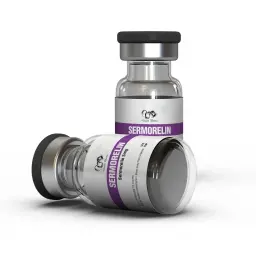
Human Peptide Hormone
Active Ingredient: Sermorelin
Concentration: 5 mg / vial
Price For: 2 mL Vial
Brand: Dragon Pharma
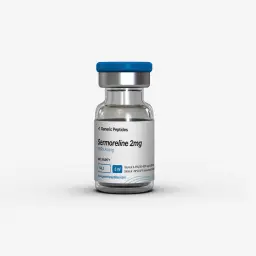
Human Peptide Hormone
Active Ingredient: Sermorelin
Concentration: 2 mg / vial
Price For: 5 mL Vial
Brand: Generic Peptides
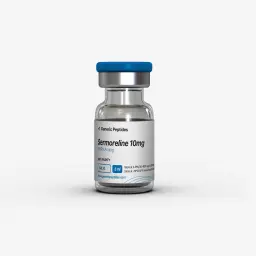
Human Peptide Hormone
Active Ingredient: Sermorelin
Concentration: 10 mg / vial
Price For: 5 mL Vial
Brand: Generic Peptides
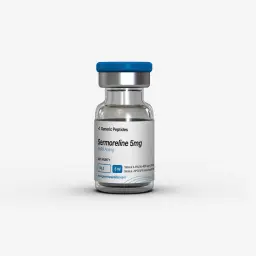
Human Peptide Hormone
Active Ingredient: Sermorelin
Concentration: 5 mg / vial
Price For: 5 mL Vial
Brand: Generic Peptides