


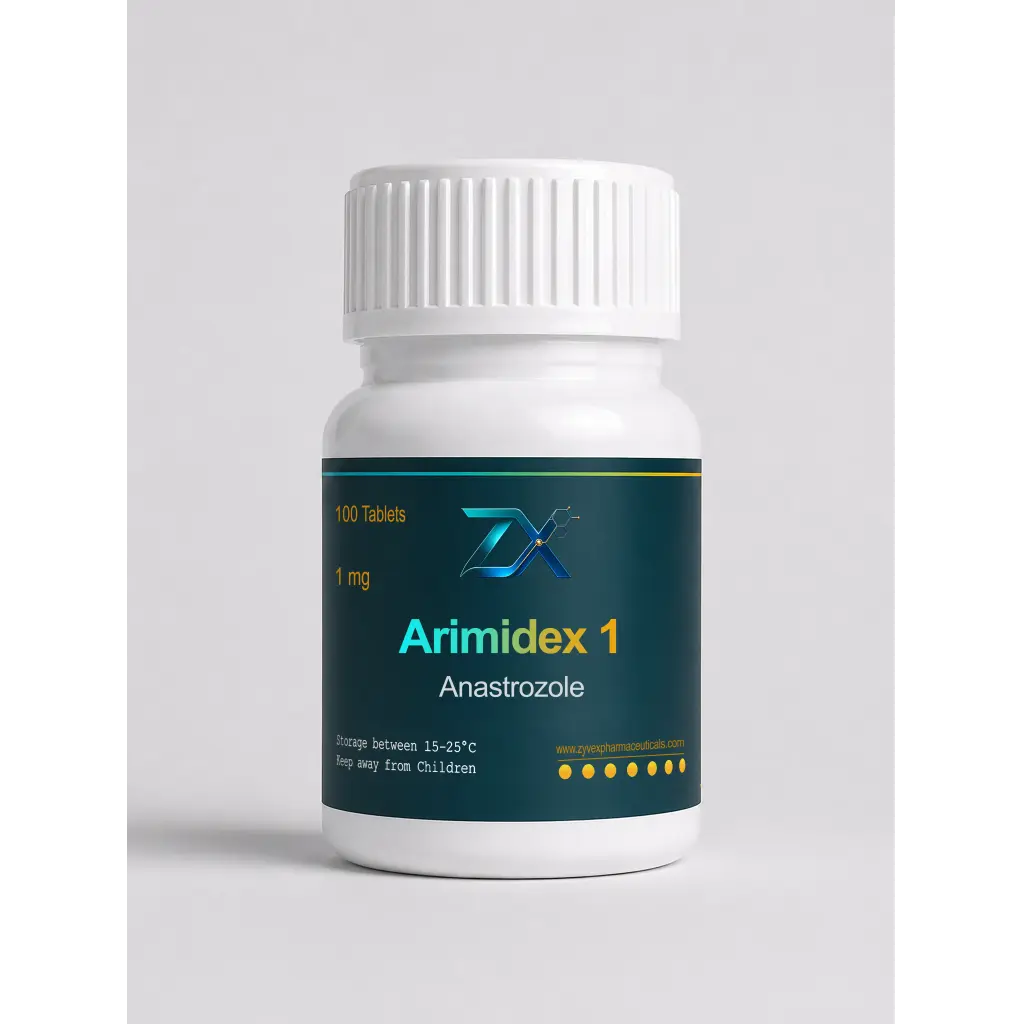
Product Class: Non-Steroidal Aromatase Inhibitor (AI)
Active Ingredient: Anastrozole
Concentration: 1 mg per tablet
Price For: 100 tablets
Brand: Arimidex
Arimidex by Zyvex Pharmaceuticals contains Anastrozole 1 mg per tablet in a pack of 100 tablets. Anastrozole is an orally active, non-steroidal aromatase inhibitor (AI) that reduces estrogen synthesis by inhibiting the aromatase enzyme responsible for converting androgens into estrogens.
Anastrozole is best established clinically in the endocrine treatment of hormone receptor-positive breast cancer in postmenopausal women. The substance is also encountered in male endocrine practice and performance-enhancement settings when control of excessive estradiol is being considered, although these applications should be distinguished from its established oncology indications.
Arimidex is not an anabolic steroid, selective estrogen receptor modulator (SERM), or testosterone replacement product. Its principal pharmacological effect is suppression of estrogen synthesis. Excessive aromatase inhibition can produce abnormally low estradiol, which may adversely affect bone, sexual, metabolic, and cardiovascular health.
Anastrozole is principally used in the management of hormone receptor-positive breast cancer in postmenopausal women. By reducing peripheral estrogen production, it decreases estrogenic stimulation of hormone-sensitive breast cancer cells.
Depending on the clinical setting and applicable prescribing information, aromatase inhibitors may be used as adjuvant endocrine therapy following primary treatment or in advanced hormone-sensitive disease. Oncology treatment should always be directed by a specialist.
Outside its primary oncology indication, Anastrozole is sometimes discussed when elevated estradiol occurs in men, including situations involving increased aromatization of testosterone.
Performance-enhancement communities commonly associate aromatase inhibitors with:
These applications should not be interpreted as justification for automatically adding an aromatase inhibitor to every testosterone or anabolic-steroid regimen. Estradiol has important physiological functions in men, and unnecessary suppression may be harmful.
Aromatase is an enzyme responsible for converting androgen precursors into estrogens. Anastrozole binds reversibly to aromatase and reduces this conversion, thereby lowering circulating estrogen concentrations.
In postmenopausal women, most estrogen is produced through peripheral aromatization rather than direct ovarian secretion. This makes aromatase inhibition particularly effective for reducing estrogen exposure in hormone-sensitive breast cancer.
In men, testosterone can also undergo aromatization to estradiol. Anastrozole can therefore lower estradiol when aromatase activity produces clinically significant estrogen excess.
Unlike Tamoxifen, Anastrozole does not primarily block estrogen receptors. Instead, it reduces estrogen synthesis itself. This distinction is important when comparing aromatase inhibitors with SERMs.
Potential benefits depend strongly on the indication and include:
The therapeutic objective is generally appropriate estrogen control rather than elimination of estrogen. Estradiol contributes to bone mineralization, sexual function, lipid metabolism, cardiovascular physiology, and other biological processes.
Anastrozole is commonly discussed alongside therapies or compounds that influence estrogen signaling. The purpose of these combinations varies considerably between legitimate medical treatment and non-medical performance use.
In anabolic-steroid communities, Anastrozole is often described as an accessory drug for aromatizing compounds such as testosterone. However, using an aromatase inhibitor without symptoms and laboratory evidence can unnecessarily reduce estradiol. Treatment decisions are better based on clinical findings and appropriately interpreted hormone testing than on a predetermined "stack."
Anastrozole is sometimes used in male endocrine practice when Testosterone Replacement Therapy (TRT) is accompanied by clinically significant estradiol elevation. Testosterone can be converted to estradiol by aromatase, particularly in adipose tissue.
However, Anastrozole is not a routine requirement for TRT. Estradiol is physiologically important in men, contributing to libido, erectile function, skeletal health, and metabolic regulation. Suppressing it excessively can be counterproductive.
When symptoms potentially related to estrogen occur during TRT, clinicians may first evaluate testosterone exposure, injection frequency, body composition, medication interactions, and measured estradiol before deciding whether pharmacological aromatase inhibition is appropriate.
Anastrozole should therefore be viewed as a specialized endocrine medication rather than an automatic component of testosterone therapy.
Dosing of Anastrozole is indication-specific. For its established oncology applications, treatment follows approved prescribing information and the patient's oncology plan. The commonly recognized pharmaceutical tablet strength is 1 mg, but tablet strength should not automatically be interpreted as the appropriate dose for every clinical situation.
When Anastrozole is considered outside its principal breast-cancer indication, dosing requires particular caution because comparatively small changes in aromatase inhibition can substantially alter estradiol concentrations between individuals.
For men receiving TRT, there is no universal Anastrozole schedule appropriate for every patient. Decisions should be individualized using symptoms, testosterone exposure, sensitive estradiol testing when appropriate, and follow-up evaluation.
Unsupervised dose escalation can result in excessive estrogen suppression. Treatment should therefore aim for the clinical objective established by the prescribing professional rather than attempting to reduce estradiol as far as possible.
Anastrozole has an established therapeutic role in postmenopausal women with selected hormone receptor-positive breast cancers. Its ability to substantially reduce peripheral estrogen synthesis forms the basis of this indication.
Use in premenopausal women is fundamentally different because functioning ovaries remain a major source of estrogen. Specialist endocrine or oncology management is therefore required when aromatase inhibition is considered in this population.
Anastrozole should not be used during pregnancy. Reduction of estrogen synthesis can interfere with normal reproductive and fetal physiology. Women who may become pregnant require appropriate medical counseling regarding reproductive considerations.
Arimidex by Zyvex Pharmaceuticals contains Anastrozole 1 mg per tablet in a 100-tablet pack. Anastrozole is a non-steroidal aromatase inhibitor that reduces estrogen synthesis and has an established role in endocrine treatment of selected hormone receptor-positive breast cancers.
Although Anastrozole is also encountered in TRT and performance-enhancement discussions, it should not be regarded as a routine companion to testosterone or anabolic steroids. Appropriate use depends on the indication, symptoms, hormone measurements, and clinical context. The objective of therapy is controlled aromatase inhibition when medically justified—not indiscriminate elimination of estrogen.
Arimidex contains Anastrozole, an aromatase inhibitor primarily used to treat selected hormone receptor-positive breast cancers in postmenopausal women. It reduces estrogen synthesis by inhibiting the aromatase enzyme.
Yes. Anastrozole inhibits aromatase and consequently decreases the conversion of androgen precursors into estrogens.
Arimidex is a well-known brand name for Anastrozole. Products containing the same active substance may be marketed under other brand or generic names.
Not routinely. Some men receiving testosterone develop clinically significant estradiol elevation, while others do not. Aromatase-inhibitor treatment should therefore be based on clinical assessment and appropriate laboratory findings rather than automatically accompanying TRT.
Because Anastrozole lowers estrogen production, it has been investigated in estrogen-related breast conditions. However, established gynecomastia may not respond adequately to aromatase inhibition, and treatment depends on the cause, duration, age, and clinical findings.
Please log in to write Arimidex review.

Product Class: Aromatase Inhibitor (AI) / Anti-Estrogen
Active Substance: Anastrozole
Concentration: 1 mg per tablet
Price For: 100 tablets
Brand: Arimidex

This Cycle Includes:
- Testaplex C250: 3 x 10 ml/vial (250 mg/ml);
- Methanoplex tab: 200 Pills (10 mg/pill);
- Arimiplex tab: 50 Pills (1 mg/pill);
Brand: Axiolabs

Aromatase Inhibitor; Antiestrogen
Active Ingredient: Anastrozole
Concentration: 1 mg / pill
Price For: 30 pills
Brand: Kalpa Pharmaceuticals

This Cycle Includes:
- Oxydrol tab: 50 Pills (50 mg/pill);
- Oxanabol tab: 200 Pills (10 mg/pill);
- Anastrozole tab: 50 Pills (1 mg/pill);
- Clomiphene tab: 50 Pills (50 mg/pill);
Brand: British Dragon