


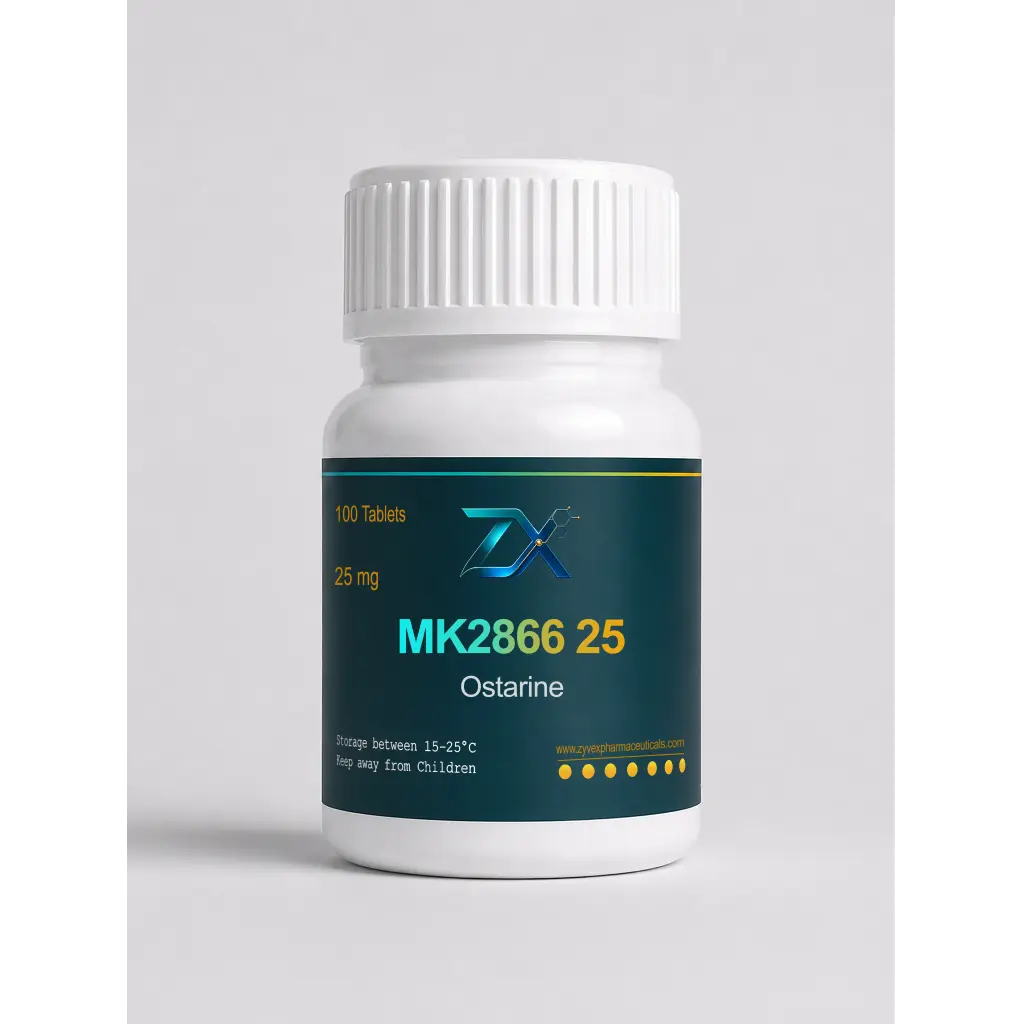
Product Class: Investigational Selective Androgen Receptor Modulator (SARM)
Active Ingredient: Enobosarm (MK-2866 / Ostarine)
Concentration: 25 mg/tab
Price For: 100 tablets
Brand: Ostarine
Ostarine (MK-2866) 25 mg by Zyvex Pharmaceuticals contains Enobosarm 25 mg per tablet and is supplied in packs of 100 tablets. Enobosarm, also known as Ostarine, MK-2866, or GTx-024, is a non-steroidal Selective Androgen Receptor Modulator (SARM) investigated for anabolic effects on skeletal muscle and other androgen-responsive tissues.
Unlike traditional anabolic-androgenic steroids, Enobosarm is chemically non-steroidal. It nevertheless acts through the androgen receptor, meaning that it can produce both anabolic effects and clinically relevant endocrine consequences.
Ostarine has been studied in human clinical development programs involving muscle wasting, lean-body-mass preservation, physical function, and related conditions. However, it has not become an FDA-approved medicine for routine human treatment, and FDA continues to identify products marketed as Ostarine/Enobosarm or MK-2866 as unapproved drugs when sold for human use.
The FDA's substance registry recognizes Enobosarm and lists MK-2866, Ostarine, and GTx-024 among its synonyms, while specifically noting that inclusion in the registry does not imply regulatory approval.
The 25 mg designation describes the stated amount of Enobosarm contained in each tablet. It should not be interpreted as an approved daily dose, bodybuilding dose, or validated performance-enhancement regimen.
Enobosarm has been investigated as a potential treatment for conditions characterized by loss of skeletal muscle, reduced lean body mass, or impaired physical function.
The scientific rationale behind SARMs is to stimulate androgen receptors in tissues such as skeletal muscle and bone while attempting to reduce some of the unwanted androgenic effects associated with conventional steroidal androgens.
Research interest has included areas such as:
Evidence that Enobosarm can alter lean body mass demonstrates pharmacological activity, but this is not equivalent to demonstrating long-term clinical benefit, improved survival, reduced disability, or acceptable long-term safety.
In bodybuilding and athletic communities, Ostarine is commonly discussed for:
Such uses are non-medical and should not be interpreted as established clinical indications. The term "selective" also should not be understood to mean harmless or free from androgenic and endocrine effects.
Enobosarm binds to the androgen receptor (AR), a nuclear receptor involved in regulation of skeletal muscle, bone, reproductive tissues, and several other physiological systems.
After receptor activation, the androgen-receptor complex alters transcription of androgen-responsive genes. In skeletal muscle, this can support anabolic signaling and influence protein metabolism and lean tissue.
Relevant pharmacological effects may include:
Unlike testosterone, Enobosarm is not converted into DHT by 5-alpha-reductase and does not undergo conventional aromatization into estradiol.
However, the absence of direct aromatization does not mean the compound is endocrine-neutral. Androgen-receptor activation can suppress hypothalamic-pituitary-gonadal signaling and reduce endogenous testosterone production.
The principal proposed or investigated benefits of Ostarine relate to preservation or improvement of lean body mass and musculoskeletal function.
Areas of interest include:
Compared with conventional anabolic steroids, SARMs were developed with the goal of achieving greater tissue selectivity. This theoretical advantage does not eliminate adverse effects.
Potential safety concerns include endocrine suppression, lipid changes, liver-enzyme abnormalities, reproductive effects, and incompletely characterized cardiovascular risks.
Long-term safety is particularly difficult to infer from short-duration clinical studies because recreational or bodybuilding exposures may differ substantially from controlled research conditions.
Ostarine is frequently discussed alongside other SARMs, anabolic compounds, and growth-related agents. These combinations are not standardized clinical therapies and can increase cumulative endocrine, metabolic, hepatic, or cardiovascular risk.
Combining multiple SARMs does not make them more "selective." Instead, overlapping androgen-receptor activation may increase endocrine suppression and complicate interpretation of adverse effects.
No medically validated bodybuilding stack involving Ostarine has been established.
Ostarine is not Testosterone Replacement Therapy.
Although Enobosarm and testosterone both activate androgen receptors, testosterone is a physiological hormone with additional metabolism into DHT and estradiol. These pathways are important for sexual function, reproductive physiology, bone health, mood, body composition, and numerous other functions.
Enobosarm does not reproduce this full hormonal environment and therefore cannot be considered an equivalent substitute for testosterone in patients with diagnosed androgen deficiency.
In addition, SARMs may suppress endogenous testosterone production through negative feedback. This means that an investigational compound promoted as "testosterone-like" may actually reduce natural testosterone output while failing to replace the complete physiological effects of testosterone.
Patients with suspected hypogonadism require appropriate endocrine evaluation rather than substitution with an unapproved SARM.
Ostarine by Zyvex Pharmaceuticals contains 25 mg of Enobosarm per tablet. A pack of 100 tablets therefore contains a stated total of 2,500 mg of Enobosarm. This calculation describes package composition only.
The 25 mg tablet strength is not an approved or universally recommended dose. Ostarine remains investigational, and there is no FDA-approved bodybuilding, cutting, muscle-preservation, or athletic-performance regimen.
Clinical studies have evaluated specific investigational doses under controlled research protocols, but those study designs should not be converted into self-directed bodybuilding cycles.
There is therefore no universally validated cycle length, loading phase, escalation schedule, SARM stack, or post-cycle regimen that can safely be inferred from a 25 mg tablet.
Higher exposure should not be assumed to provide proportionally greater benefit because increasing androgen-receptor stimulation can also increase endocrine suppression and other adverse effects.
Ostarine was developed to provide more selective androgen-receptor activity than traditional anabolic steroids, but it remains an androgen-receptor agonist.
Potential androgenic or endocrine concerns in women may include:
The risk of virilization may not be identical to that associated with potent anabolic steroids, but SARM selectivity should not be interpreted as proof of safety in women.
The 25 mg tablet strength does not represent a validated female bodybuilding dose.
Pregnancy presents particular concern because compounds that activate androgen receptors could interfere with normal fetal development. Adequate reproductive safety has not been established for non-medical Enobosarm exposure.
Traditional anabolic steroids are steroidal derivatives of testosterone, DHT, or related hormones. Ostarine is chemically non-steroidal but still activates androgen receptors. Its structural differences can influence tissue selectivity and metabolism, but they do not eliminate suppression of endogenous hormones or other systemic risks.
Ostarine (MK-2866) 25 mg by Zyvex Pharmaceuticals contains Enobosarm 25 mg per tablet and is supplied in packs of 100 tablets. Enobosarm is an investigational, orally active selective androgen receptor modulator developed to influence anabolic signaling in skeletal muscle and related tissues.
Ostarine has undergone human clinical investigation and can affect lean body mass, but it remains an unapproved drug in the United States and is not established as a bodybuilding, cutting, or testosterone-replacement medication. Its non-steroidal structure does not eliminate endocrine suppression, lipid changes, hepatic concerns, reproductive effects, or other systemic risks. The 25 mg designation describes tablet strength rather than a validated performance regimen, and Enobosarm remains prohibited in drug-tested competitive sport.
Ostarine, also known as MK-2866, GTx-024, or Enobosarm, is an investigational non-steroidal selective androgen receptor modulator.
Yes. Enobosarm is the recognized substance name, while Ostarine, MK-2866, and GTx-024 are commonly used synonyms.
No. Ostarine is chemically non-steroidal, although it produces anabolic effects by activating androgen receptors.
No. Enobosarm is not a conventional aromatase substrate and does not directly convert to estradiol like testosterone. Endocrine suppression can nevertheless alter the overall androgen-estrogen balance.
Ostarine can suppress endogenous hormone signaling, but there is no universally validated medical post-cycle protocol for recreational SARM use. Recovery varies according to exposure and individual endocrine physiology.
Please log in to write Ostarine MK-2866 review.
Selective Androgen Receptor Modulator
Active Ingredient: Ostarine
Concentration: 25 mg / pill
Price For: 100 pills
Brand: Dragon Pharma
Aromatase Inhibitor; Antiestrogen
Active Ingredient: Anastrozole
Concentration: 1 mg / pill
Price For: 50 pills
Brand: British Dragon Pharmaceuticals
Selective Estrogen Receptor Modulator; Progonadotropin
Active Ingredient: Clomiphene Citrate
Concentration: 50 mg / pill
Price For: 50 pills
Brand: British Dragon Pharmaceuticals
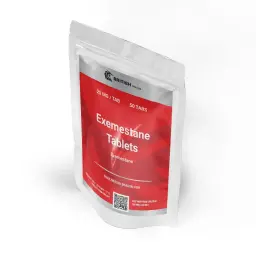
Aromatase Inhibitor; Antiestrogen
Active Ingredient: Exemestane
Concentration: 25 mg / pill
Price For: 50 pills
Brand: British Dragon Pharmaceuticals