


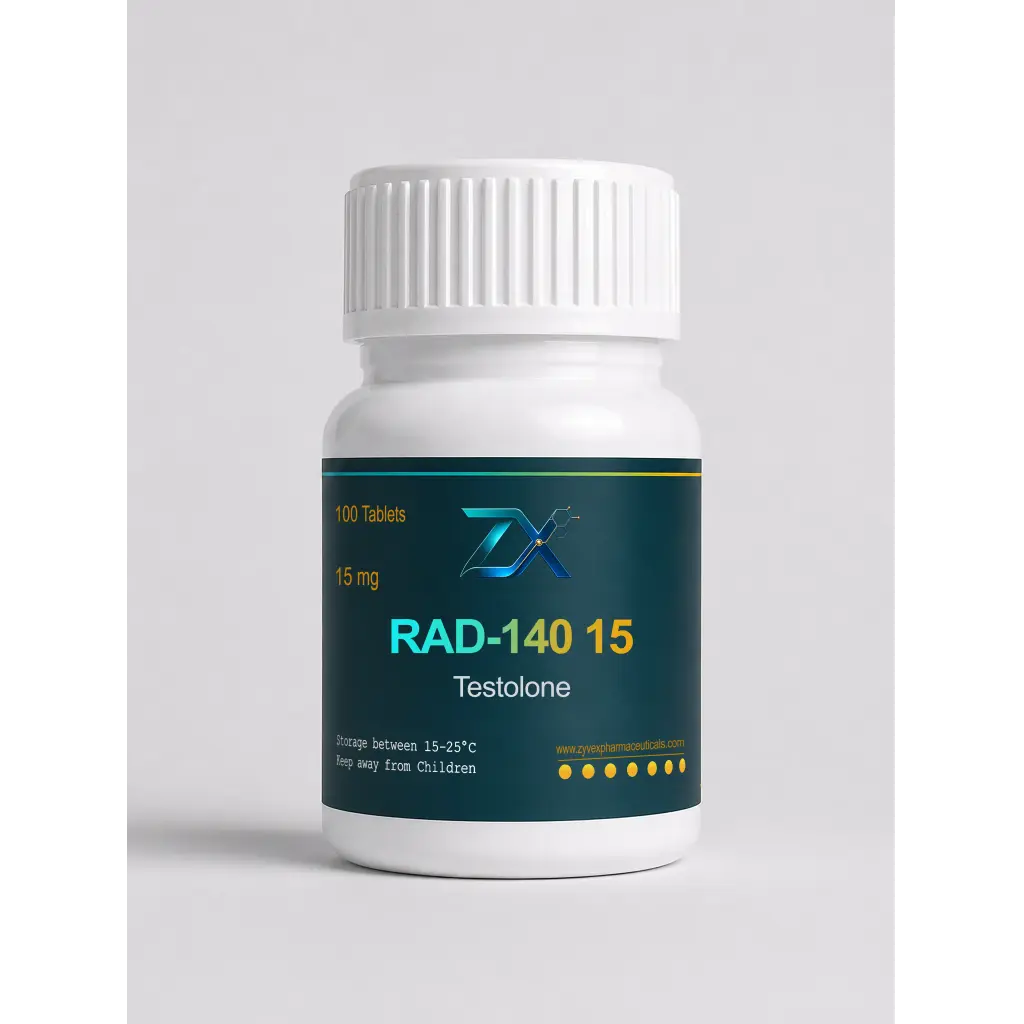
Product Class: Investigational Selective Androgen Receptor Modulator (SARM)
Active Ingredient: Testolone (RAD-140 / Vosilasarm)
Concentration: 15 mg/tab
Price For: 100 tablets
Brand: Testolone
Testolone (RAD-140) 15 mg by Zyvex Pharmaceuticals contains 15 mg of Testolone per tablet and is supplied in packs of 100 tablets. RAD-140, also known as Testolone and Vosilasarm, is an orally active, non-steroidal Selective Androgen Receptor Modulator (SARM) developed to activate androgen receptors while attempting to achieve a more tissue-selective pharmacological profile than conventional anabolic-androgenic steroids.
RAD-140 is chemically distinct from Testosterone, Trenbolone, Oxandrolone, and other steroidal androgens, but it still acts through the androgen receptor (AR). This means its non-steroidal structure does not eliminate anabolic, androgenic, endocrine, hepatic, or metabolic effects.
RAD-140 has undergone limited human clinical evaluation. A first-in-human Phase 1 study evaluated RAD-140 as an androgen-receptor-targeted agent in postmenopausal women with estrogen-receptor-positive, HER2-negative metastatic breast cancer. The study confirmed human androgen-receptor engagement but also reported frequent liver-enzyme abnormalities and other adverse events. RAD-140 has not become an FDA-approved medicine for bodybuilding, muscle growth, hormone replacement, or routine cancer therapy.
FDA continues to identify products marketed as RAD-140/Testolone for human use as unapproved new drugs. The 15 mg tablet strength should therefore be interpreted as stated product content rather than an approved therapeutic or athletic-performance dose.
RAD-140 was developed as a tissue-selective androgen-receptor modulator and has been investigated for potential applications involving androgen-responsive tissues.
Research interest has included:
The most important published human study to date involved women with advanced ER-positive/HER2-negative breast cancer. RAD-140 demonstrated pharmacological androgen-receptor activity, but this small Phase 1 oncology trial does not establish RAD-140 as a broadly approved or safe medicine.
In bodybuilding and physique communities, Testolone is commonly discussed in relation to:
These are non-approved applications. Claims that RAD-140 can provide steroid-like muscle growth without steroid-like adverse effects are not supported by adequate long-term human evidence.
FDA has specifically challenged marketing claims that RAD-140 can stimulate major muscle growth, improve strength, or provide anabolic benefits with reduced toxicity, classifying marketed RAD-140 products as unapproved drugs.
RAD-140 binds to the androgen receptor, a nuclear receptor involved in regulation of skeletal muscle, bone, reproductive tissues, and many other physiological systems.
Following receptor binding, the activated androgen-receptor complex can alter transcription of androgen-responsive genes. This provides the biological basis for its anabolic effects in experimental models.
Potential androgen-receptor-mediated actions include:
Unlike Testosterone, RAD-140 is not a physiological precursor for DHT or estradiol. It is not conventionally aromatized to estrogen and is not converted to DHT through 5-alpha-reductase.
However, androgen-receptor activation can still produce negative endocrine feedback. Consequently, RAD-140 may suppress endogenous testosterone and gonadotropin signaling even though it does not directly convert to estrogen.
The potential benefits attributed to RAD-140 are primarily based on its androgen-receptor activity and experimental anabolic effects.
Research and non-medical interest include:
RAD-140 has often been described as having a favorable anabolic-to-androgenic profile in experimental systems. Such selectivity should not be interpreted as proof of safety in humans.
Human data remain limited. In the published Phase 1 oncology study, common treatment-emergent adverse events included elevations in AST, ALT, and bilirubin, as well as vomiting, dehydration, decreased appetite, and weight loss. The trial also demonstrated clear androgen-receptor engagement in patients.
These findings reinforce an important distinction: RAD-140 is pharmacologically active in humans, but evidence of receptor activity does not demonstrate a favorable long-term risk-benefit profile for healthy users.
RAD-140 is commonly discussed with other SARMs, anabolic compounds, and growth-related agents. These combinations are not validated clinical protocols.
Combining several SARMs does not increase tissue selectivity. Instead, it may increase overall androgenic exposure, endogenous testosterone suppression, lipid disturbances, hepatic stress, and uncertainty regarding adverse effects.
Likewise, adding Testosterone does not convert RAD-140 use into legitimate TRT or make an investigational SARM medically supervised by default.
Testolone is not Testosterone Replacement Therapy.
Although both RAD-140 and Testosterone activate androgen receptors, Testosterone is a naturally occurring steroid hormone that also serves as a precursor to DHT and estradiol. These metabolites are important for bone, sexual function, reproductive physiology, mood, and other endocrine functions.
RAD-140 does not reproduce this complete physiological environment.
It therefore should not be considered an equivalent replacement for Testosterone in men with confirmed hypogonadism.
Moreover, androgen-receptor activation from RAD-140 may suppress natural gonadotropin and testosterone production through negative feedback. A compound can therefore provide androgen-receptor stimulation while simultaneously impairing endogenous androgen production.
Testolone by Zyvex Pharmaceuticals contains 15 mg per tablet. A pack of 100 tablets therefore contains a stated total of 1,500 mg of RAD-140. This calculation describes package composition only.
The 15 mg tablet strength is not an approved or universally recommended dose.
There is no FDA-approved RAD-140 regimen for:
The published first-in-human oncology study used substantially different experimental doses under specialist clinical-trial supervision in patients with metastatic cancer. Those oncology study doses should not be extrapolated into bodybuilding recommendations because the population, objective, monitoring, and risk tolerance were fundamentally different.
There is therefore no validated bodybuilding cycle, loading schedule, escalation plan, SARM stack, or universal post-cycle regimen that can safely be inferred from a 15 mg tablet.
RAD-140 is non-steroidal but remains an androgen-receptor agonist. Consequently, women may experience androgenic effects despite its SARM classification.
Potential concerns include:
Notably, the principal published human RAD-140 trial involved postmenopausal women with metastatic breast cancer, but those findings should not be interpreted as evidence that RAD-140 is safe for healthy women or for performance enhancement.
Pregnancy presents a major concern because androgen-receptor agonism could interfere with normal fetal development.
The 15 mg tablet strength does not represent a validated female dose.
Traditional anabolic steroids are steroidal derivatives of Testosterone, DHT, or related hormones. RAD-140 is chemically non-steroidal but still acts through androgen receptors. The distinction may alter metabolism and tissue distribution, but it does not eliminate endocrine or systemic toxicity.
Testolone RAD-140 15 mg by Zyvex Pharmaceuticals contains 15 mg per tablet and is supplied in packs of 100 tablets. RAD-140 is an investigational, orally active selective androgen receptor modulator with demonstrated human androgen-receptor activity.
Although RAD-140 has attracted substantial interest for lean mass, strength, and body-composition applications, it is not an approved bodybuilding or TRT medicine. Human evidence remains limited, and published clinical research has documented significant liver-enzyme abnormalities and other adverse effects. Its non-steroidal structure does not eliminate endocrine suppression or other systemic risks. The 15 mg designation therefore represents stated tablet strength rather than a validated performance-enhancement regimen.
Testolone, also known as RAD-140 or Vosilasarm, is an investigational non-steroidal selective androgen receptor modulator.
Yes. RAD-140 is a selective androgen receptor modulator and is pharmacologically classified among non-steroidal androgen-receptor agonists.
No. RAD-140 is chemically non-steroidal. However, it activates androgen receptors and can produce anabolic and endocrine effects that overlap with those of anabolic steroids.
No. Fifteen milligrams describes the stated tablet strength. It should not be interpreted as an approved bodybuilding, strength, or muscle-building dose.
RAD-140 can suppress endogenous endocrine signaling, but there is no universally validated medical post-cycle protocol for recreational SARM use. Recovery depends on the extent and duration of exposure and individual endocrine physiology.
Please log in to write Testolone RAD-140 review.