


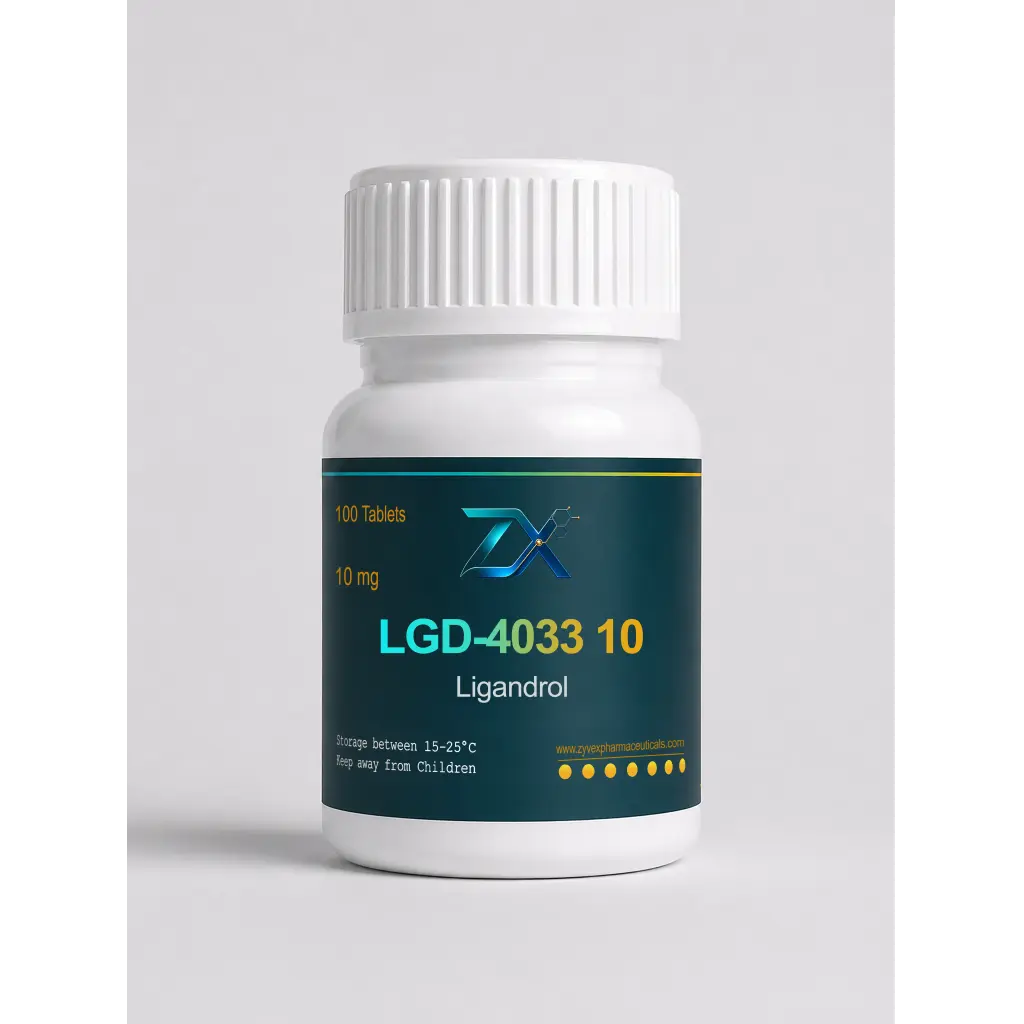
Product Class: Investigational Selective Androgen Receptor Modulator (SARM)
Active Ingredient: Ligandrol (LGD-4033)
Concentration: 10 mg/tab
Price For: 100 tablets
Brand: Ligandrol
Ligandrol (LGD-4033) 10 mg by Zyvex Pharmaceuticals contains Ligandrol 10 mg per tablet and is supplied in packs of 100 tablets. Ligandrol, also known as LGD-4033, is an orally active, non-steroidal Selective Androgen Receptor Modulator (SARM) developed for investigational applications involving muscle and bone biology.
LGD-4033 is designed to activate the androgen receptor (AR) while producing a pattern of activity that differs from traditional anabolic-androgenic steroids. The SARM concept seeks greater tissue selectivity, particularly anabolic activity in skeletal muscle and bone, while potentially limiting androgenic stimulation in other tissues.
Ligandrol is not testosterone and is structurally distinct from steroidal androgens such as Testosterone, Nandrolone, Oxandrolone, or Stanozolol. It also should not be confused with MK-677 (Ibutamoren), which is a growth-hormone secretagogue rather than a SARM.
LGD-4033 has been evaluated in human clinical research, including studies examining lean body mass and endocrine effects. However, Ligandrol is not an approved routine medication for bodybuilding, muscle growth, testosterone replacement, or athletic performance enhancement.
The 10 mg designation describes the stated quantity of Ligandrol contained in each tablet. It should not be interpreted as a recommended daily dose, bodybuilding dose, or validated performance regimen.
Ligandrol has been investigated because selective androgen-receptor modulation could theoretically provide anabolic effects in muscle and bone while reducing some unwanted effects associated with conventional androgen therapy.
Research interest has included conditions characterized by loss of lean tissue, impaired physical function, or altered musculoskeletal physiology. Potential therapeutic concepts surrounding SARMs have included muscle wasting, sarcopenia, frailty, and related disorders.
Early human research demonstrated that LGD-4033 is biologically active and can influence lean body mass and endocrine markers. Such findings establish pharmacological activity but do not by themselves demonstrate an acceptable long-term risk-benefit profile or regulatory approval for routine clinical treatment.
In bodybuilding and performance communities, Ligandrol is commonly discussed in relation to:
Although SARMs are sometimes marketed as safer substitutes for anabolic steroids, this description can be misleading. Tissue selectivity is a pharmacological objective rather than a guarantee of safety.
LGD-4033 can produce systemic endocrine effects, including suppression of endogenous sex-hormone signaling. Its non-steroidal structure therefore should not be interpreted as meaning that it cannot produce clinically significant adverse effects.
Ligandrol binds to and activates the androgen receptor, a nuclear receptor involved in regulation of muscle, bone, reproductive tissues, and numerous other physiological processes.
Following receptor binding, the activated androgen-receptor complex influences transcription of androgen-responsive genes. In skeletal muscle, this can promote anabolic signaling and influence protein metabolism and lean-tissue development.
Potential androgen-receptor-mediated effects include:
Unlike testosterone, LGD-4033 is not converted to DHT by 5-alpha-reductase and is not a conventional aromatase substrate that converts directly into estradiol.
This distinction does not eliminate endocrine consequences. Androgen-receptor activation can produce negative feedback at the hypothalamic and pituitary levels, reducing gonadotropin signaling and endogenous testosterone production.
Consequently, a compound can be non-aromatizing and non-steroidal while still producing clinically relevant testosterone suppression.
Potential benefits investigated or discussed for Ligandrol primarily relate to its anabolic activity in muscle and other androgen-responsive tissues.
Areas of interest include:
A controlled human study of LGD-4033 demonstrated dose-related increases in lean body mass during short-term exposure, providing evidence that the compound has measurable anabolic activity in humans.
However, increased lean body mass is not synonymous with proven improvements in strength, athletic performance, disability prevention, or long-term clinical outcomes.
Potential anabolic effects must also be considered alongside endocrine and metabolic changes. Research has demonstrated suppression of testosterone and other hormone-related markers during exposure. Changes in lipid parameters can also occur.
Long-term cardiovascular, hepatic, reproductive, and endocrine safety remains particularly important because short-duration research cannot establish the consequences of prolonged or high-exposure non-medical use.
LGD-4033 is frequently discussed alongside other SARMs, growth-related compounds, and anabolic agents. These combinations are not established clinical protocols and may increase endocrine, hepatic, cardiovascular, or metabolic risk.
Using multiple SARMs simultaneously should not be assumed to improve tissue selectivity. Greater cumulative androgen-receptor stimulation can instead increase endocrine suppression and make adverse effects more difficult to attribute to a particular compound.
Likewise, adding testosterone or another anabolic steroid does not make Ligandrol use medically equivalent to hormone replacement.
Ligandrol is not Testosterone Replacement Therapy. Although both testosterone and LGD-4033 interact with androgen receptors, their endocrine physiology differs substantially.
Testosterone is an endogenous hormone that acts directly through androgen receptors and also serves as a precursor to DHT and estradiol. These metabolites contribute to sexual function, bone health, reproductive physiology, body composition, and other biological processes.
Ligandrol does not reproduce this complete hormonal environment and should not be considered a substitute for testosterone in patients with clinically diagnosed hypogonadism.
Furthermore, LGD-4033 can suppress endogenous endocrine signaling. Negative feedback may reduce gonadotropin activity and endogenous testosterone concentrations.
This makes the distinction between SARM exposure and TRT particularly important. A compound can activate androgen receptors while simultaneously reducing natural testosterone production.
Patients with suspected testosterone deficiency require appropriate clinical evaluation rather than substitution with an investigational SARM.
Ligandrol by Zyvex Pharmaceuticals contains 10 mg per tablet. A pack of 100 tablets therefore contains a stated total of 1,000 mg of Ligandrol. This calculation describes package composition only.
The 10 mg tablet strength is not a universally recommended dose. LGD-4033 remains investigational and does not have an established regulator-approved bodybuilding or athletic-performance regimen.
Controlled clinical research has investigated LGD-4033 at defined experimental exposures, but study protocols should not be extrapolated into self-directed bodybuilding cycles. Experimental research doses are selected for specific study objectives, populations, durations, and monitoring procedures.
There is therefore no validated bodybuilding cycle, loading phase, escalation schedule, SARM stack, or post-cycle regimen that can safely be inferred from a 10 mg tablet.
Endocrine suppression is particularly relevant when exposure increases. Because LGD-4033 can reduce endogenous testosterone-related signaling, the assumption that a SARM requires no endocrine monitoring is incorrect.
Ligandrol was developed with the objective of achieving greater tissue selectivity than traditional anabolic steroids, but it remains an androgen-receptor agonist. Consequently, the possibility of androgenic effects in women cannot be dismissed.
Potential concerns include:
The androgenic risk profile of LGD-4033 should not be assumed equivalent to that of traditional anabolic steroids, but neither should "selective" be interpreted as "female-safe."
The 10 mg tablet strength does not represent a validated female performance dose. Human evidence is insufficient to establish a safe bodybuilding regimen for women.
Pregnancy presents a particular concern. Compounds that modify androgen-receptor signaling may interfere with fetal development, making exposure inappropriate when pregnant or attempting conception.
Traditional anabolic steroids are steroidal derivatives of testosterone, DHT, or related hormones. Ligandrol is chemically non-steroidal but activates the same broad androgen-receptor system. Its different chemical structure may alter tissue distribution and metabolism, but does not eliminate endocrine or systemic risk.
Ligandrol (LGD-4033) 10 mg by Zyvex Pharmaceuticals contains Ligandrol 10 mg per tablet and is supplied in packs of 100 tablets. LGD-4033 is an investigational, orally active selective androgen receptor modulator developed to produce anabolic signaling in tissues such as skeletal muscle and bone.
Human research demonstrates that Ligandrol is biologically active and can influence lean body mass and endocrine function. However, tissue selectivity does not make LGD-4033 risk-free: endogenous testosterone suppression, lipid changes, reproductive effects, and incompletely characterized long-term safety remain important considerations. Ligandrol is not TRT, is not equivalent to MK-677, and is not an approved bodybuilding medication. The 10 mg designation describes tablet strength rather than a validated performance-enhancement dose or treatment regimen.
Ligandrol, or LGD-4033, is an investigational orally active selective androgen receptor modulator developed to study anabolic effects in muscle and bone.
Yes. LGD-4033 belongs to the selective androgen receptor modulator class and is pharmacologically distinct from anabolic steroids and growth-hormone secretagogues.
No. Ligandrol is chemically non-steroidal. However, it activates androgen receptors and can produce anabolic and endocrine effects that overlap in some respects with anabolic steroids.
Controlled human research has demonstrated that LGD-4033 can increase lean body mass during short-term exposure. This does not establish it as an approved or safe bodybuilding treatment, nor does increased lean mass automatically translate into proportional strength or performance improvements.
No. Ligandrol is a SARM that activates androgen receptors. MK-677, or Ibutamoren, is a ghrelin-receptor agonist that stimulates endogenous growth hormone secretion.
Please log in to write Ligandrol LGD-4033 review.
Product Class: Selective Androgen Receptor Modulator (SARM)
Active Ingredient: Ligandrol (LGD-4033)
Concentration: 15 mg per tablet
Price For: 100 tablets
Brand: Ligandrol